Wheel balancing versus alignment: two jobs, different measurements
Balancing addresses mass distribution in a rotating tyre-and-wheel assembly. Alignment addresses the orientation of the wheels and steering axes relative to the vehicle and road. Adding a wheel weight does not adjust toe; adjusting toe does not correct an assembly's imbalance. Continental, Balancing tires Continental, Wheel Alignment
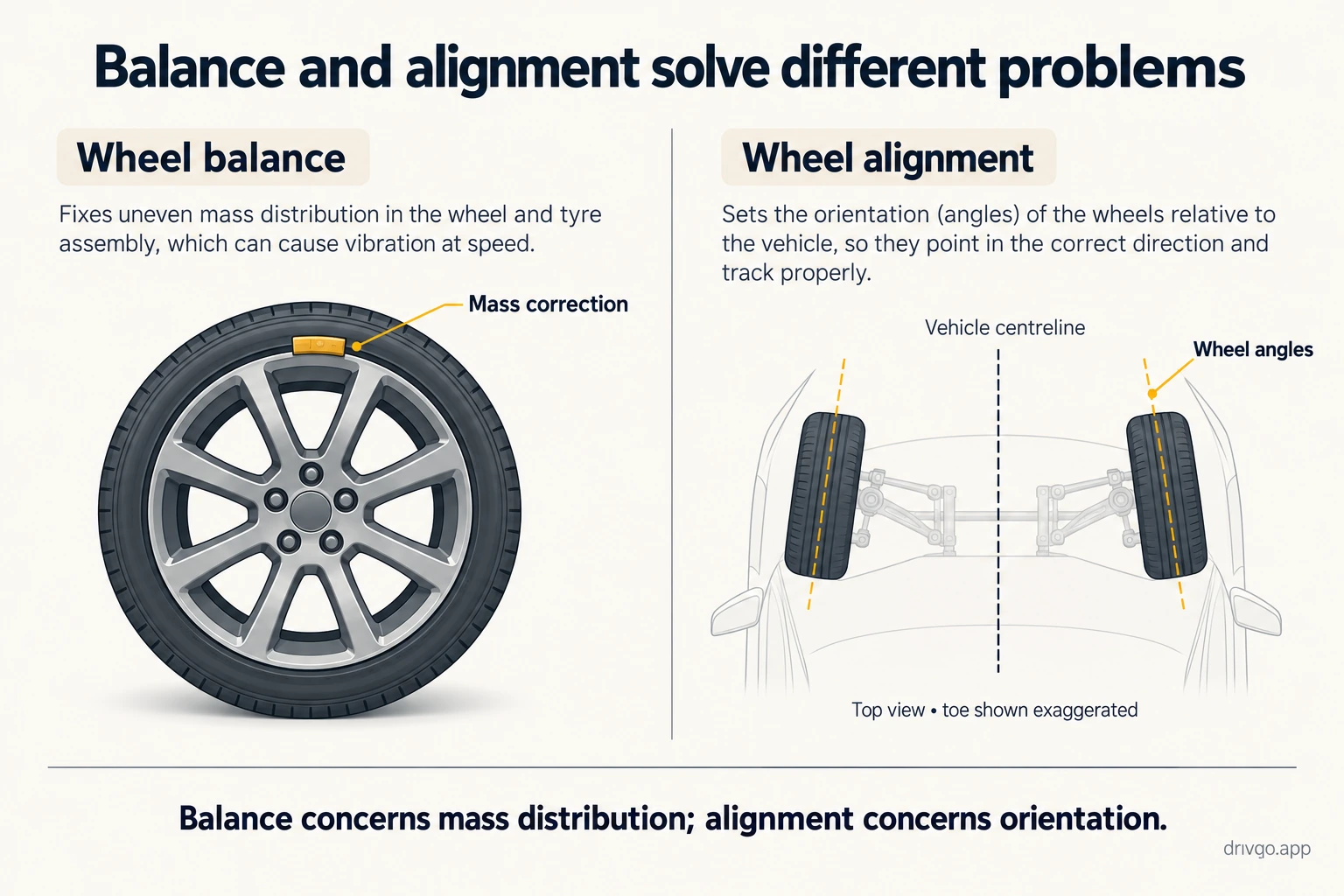
Illustrative geometry and weight placement only. No alignment targets or balancing-weight values are prescribed.
What the balancing machine measures
A tyre and wheel can be round enough to roll yet still have uneven mass distribution. Balancing equipment measures the assembly and identifies corrective weight placement. Continental distinguishes static balancing from dynamic balancing; the latter addresses more complex imbalance using a rotating measurement process. Continental, Balancing tires: how tyres are balanced
The important object is the complete assembly. A wheel weight is a correction for that assembly's measured condition, not a treatment for every possible cause of vibration. A symptom such as steering-wheel shake deserves investigation rather than an automatic diagnosis from its name alone.
What road-force measurement adds
Hunter's Road Force equipment uses a load roller to assess the tyre-and-wheel assembly under load as well as performing balance measurements. Its published description distinguishes those diagnostic measurements from conventional balancing and describes assessing rim runout and potential match-mounting solutions. Hunter Engineering, Road Force WalkAway: diagnostic load roller and ForceMatch
This explains why a “balanced” assembly can still need further investigation. Balance and loaded rolling behaviour are different measurements. The equipment's existence does not establish that every vibration originates in the tyre or that every vehicle needs the same service.
What alignment measures
Three common terms describe different views:
- Camber: the wheel's tilt from vertical, viewed from the front or rear.
- Toe: the direction the wheels point relative to one another, viewed from above.
- Caster: steering-axis inclination viewed from the side.
Caster is an angle of the steering axis, not simply the visible lean of the tyre. The target values are vehicle-specific; there is no single universal “straight” setting for all three. Continental, Wheel Alignment: camber, toe and caster
Read the report before judging the colours
An alignment report needs the correct vehicle selection, measured angles and relevant specification limits. Hunter's WinAlign manual describes summary reports and before/current formats, including the option to mark measurements outside specification. The report is therefore a record of measurements against a selected reference, not just a page of red and green boxes. Hunter, WinAlign operation manual, Aligner Set-Up: report format, printed p. 200
Ask what was measured before and after, what reference was selected and which adjustments the actual suspension permits. Do not invent a target angle from another model's printout. An unexplained out-of-range result needs interpretation, not a promise that every angle can be adjusted independently.
Why wheel-weight materials changed
The US EPA’s archived National Lead-Free Wheel Weight Initiative records an industry effort to reduce lead use and encourage alternatives such as steel. Its January 2009 fact sheet documents the initiative’s historical aims; it is not a statement of current rules in every jurisdiction. The material can change while the balancing task stays the same: place the appropriate corrective mass where the measured assembly requires it. EPA, National Lead-Free Wheel Weight Initiative, archived fact sheet, January 2009
Put the two services in context
Balancing follows the rotating assembly; alignment follows geometry. A careful inspection may consider both, but one service does not substitute for the other. Our suspension-layout guide helps explain the geometry, while suspension travel explains why wheel orientation can change as the suspension moves.
Illustration: AI-generated and checked against the explanation. Conceptual only; sources are linked beside the relevant claims.