Why suspension travel matters: bump stops, ride height and usable movement
Suspension needs room to move as well as enough force to support and control the car. Spring rate describes resistance to compression; available travel describes how far the system can move. Increasing one does not magically restore the other.
BILSTEIN's discussion of suspension myths stresses the need to preserve residual spring travel when lowering a vehicle. It also distinguishes the vehicle's original compression buffers from additional retrofit stops that consume useful movement. BILSTEIN, Fact checking of shock absorber myths, myths 5–6
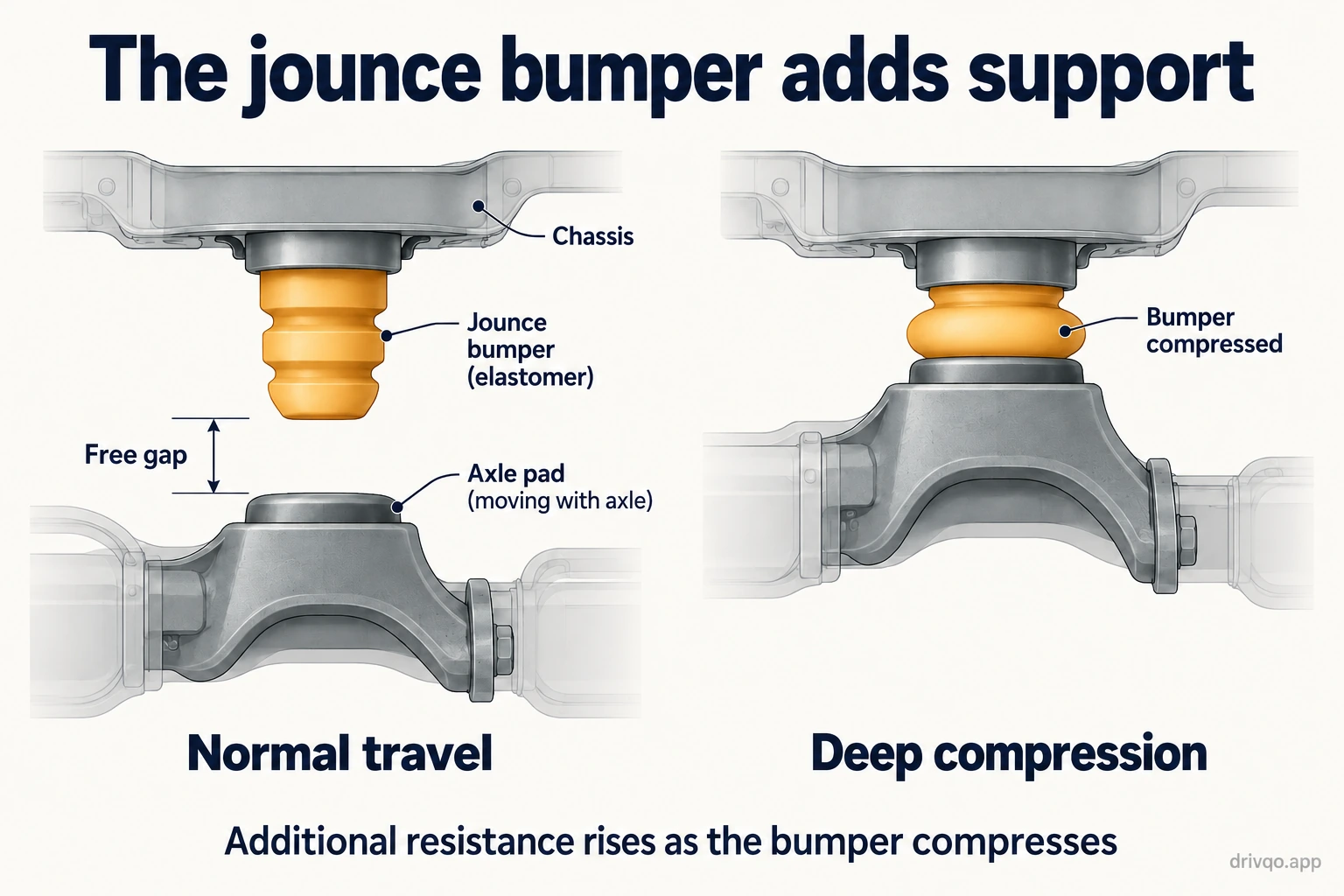
The bumper compresses progressively; contact is not necessarily an instant rigid stop. The drawing is not a ride-height specification.
Jounce and rebound describe opposite directions
When a wheel moves upward relative to the body, the suspension moves into compression, often called jounce or bump. Movement the other way is rebound or droop. At normal ride height, the system needs an appropriate range in both directions.
The wheel, spring and damper do not necessarily travel by the same distance. Suspension links and mounting positions determine the relationship. Therefore a visible gap at one component is not automatically the amount of remaining wheel travel. A useful description specifies what is moving and relative to what.
A bump stop can be a spring aid
The name makes a bump stop sound like a hard block waiting for a rare impact. In many designs, its material and shape provide progressive resistance as compression increases. BASF describes Cellasto jounce bumpers in terms of load-deflection characteristics, energy absorption and the management of peak loads. BASF, Cellasto chassis applications: jounce bumper
Its technical presentation explicitly identifies progressivity of the overall spring characteristic as a design benefit. Once such a bumper engages, it contributes to the suspension's response; it is not merely an emergency metal-contact preventer. BASF, Cellasto: NVH solutions in PU, jounce-bumper section, p. 4
That does not mean all bump stops share a material, shape or engagement point. Nor does it mean removing or trimming one is a universal cure for a harsh ride.
Why lowering changes the problem
Lowering can move the suspension's static position closer to its compression limit. The actual result depends on the spring, damper length, mounts and geometry. A shorter spring alone does not establish that the rest of the assembly has an appropriate working range.
BILSTEIN describes its B8 damper as a shortened design intended to preserve the appropriate spring preload and travel with lowering springs. This is a product-specific example of matching components, not a claim that any shortened damper works with any spring. BILSTEIN, B8 product explanation
What this can explain—and what it cannot
The interaction of primary springs, dampers and bump stops helps explain why a car's response can change as it uses more travel. It does not, on its own, prove that a named historic car had a particular handling defect. The often-repeated allegation about the Triumph TR3B requires a period test or engineering analysis identifying that model and mechanism; it is not asserted here.
For related ideas, see anti-roll bars and handling balance. A bar changes the relationship between the two sides, while bump-stop engagement changes the response near a travel limit. Both belong in the description of the complete suspension.
Illustration: AI-generated and checked against the explanation. Conceptual only; sources are linked beside the relevant claims.