How anti-roll bars work: body roll, camber and handling balance
An anti-roll bar is a spring that mainly resists different suspension movements on the two sides of an axle. It can reduce body roll, but it also changes how that axle responds to uneven roads and cornering loads. “Stiffer” describes a component; it does not, by itself, mean “more grip.” Eibach, Anti-Roll-Kit: operating explanation
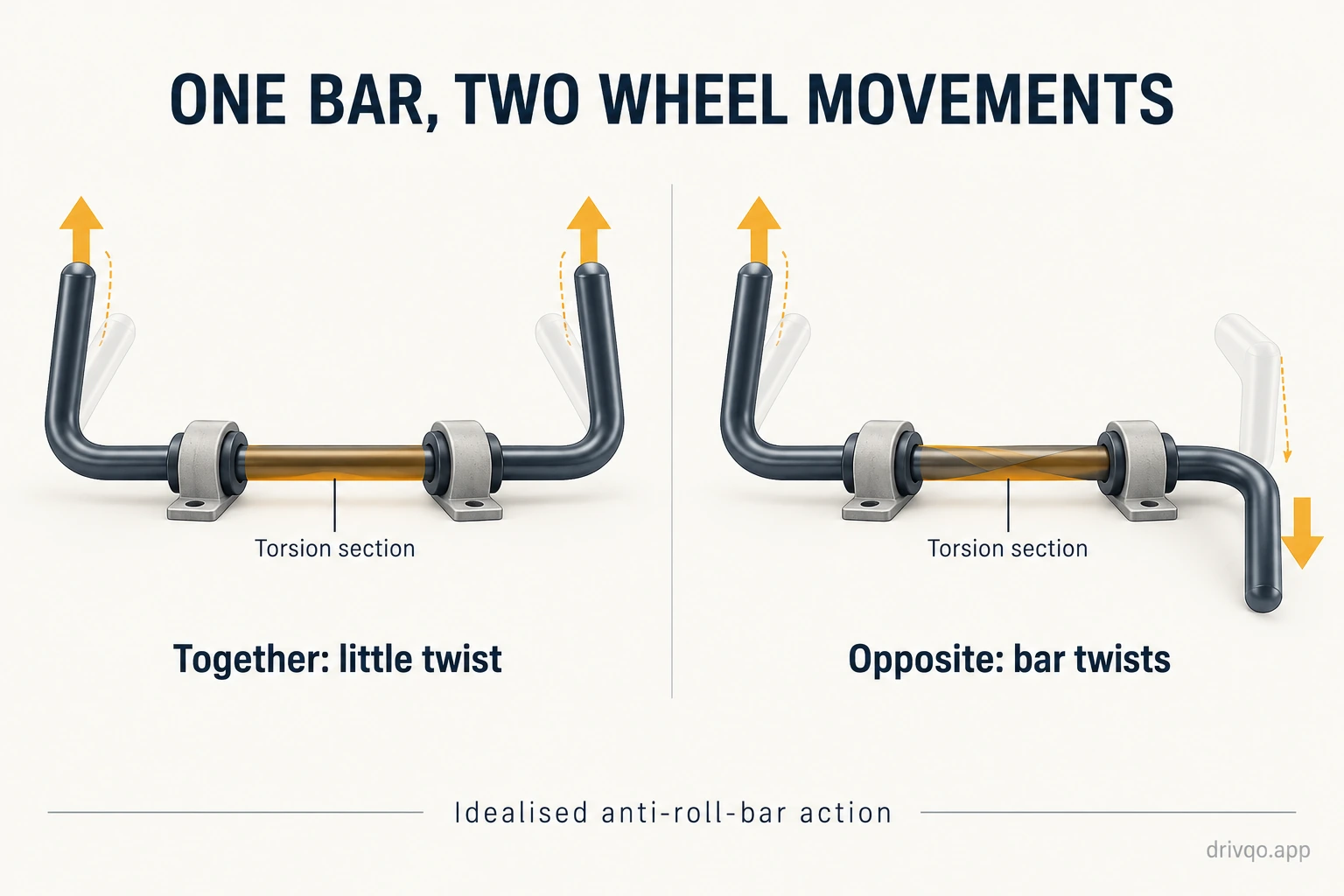
The arrows show imposed movement, not the direction of the bar's resisting forces. Real installation geometry changes the motion ratio.
Follow the movement before thinking about cornering
Picture a U-shaped bar attached to the body through bushes, with its ends connected to the left and right suspension. When both wheels move upward together by similar amounts, the bar can largely rotate in its mounts. When one side moves upward relative to the other, the ends try to rotate the central section differently. The resulting twist produces a restoring torque.
This also explains the single-wheel-bump trade-off. The bar cannot know whether unequal wheel movement comes from cornering or a pothole. Linking the sides changes the forces transmitted during both events. Eibach's description establishes the basic left-right connection; exact wheel forces depend on the installed lever lengths and geometry. Eibach, Control the Roll
Less roll and less load transfer are different things
Body roll is an angle. Lateral load transfer is a change in the loads carried by the inside and outside tyres. They are related through the vehicle's geometry and compliance, but they are not interchangeable measurements.
A stiffer bar can make the body appear flatter while changing the front-to-rear distribution of load transfer. The tyres' response to loading is why that distribution matters. A published study of anti-roll-bar stiffness examines its effects on roll and handling using a specified vehicle model; it is not evidence that the same bar change improves every vehicle. Gupta et al., SAE 2019-26-0068, Modeling and Simulation of Steady State Handling Characteristics of Formula Vehicle with Antiroll Bars, public abstract
Why front and rear adjustment can change balance
Whiteline's vehicle-specific approval document gives a concrete example: a harder rear/softer front setting promotes oversteer, while the reverse promotes understeer. The same document identifies the shorter lever arm as the harder setting. This is useful evidence for the direction of the adjustment on the covered application, not a universal road-car tuning prescription. Whiteline / TÜV Rheinland, setting guidance, report AU-TG751-00362/10-02, section IV.3
Understeer means the car needs more steering angle as cornering demand rises; oversteer describes the opposite tendency. The result of a real modification also depends on tyres, springs, dampers, differential behaviour and the original balance. Selecting a bar from diameter alone misses the influence of material, wall thickness and effective lever length.
Where camber fits in
Camber is the wheel's tilt when viewed from the front or rear. Body roll and suspension travel both affect the relationship between tyre and road. Reducing roll may preserve a more useful tyre orientation in a particular geometry, but it does not establish that every tyre gains grip in every corner. Continental, Wheel Alignment: camber
The useful question is therefore not simply “How flat does it look?” It is “How does the complete suspension keep the tyres working?” Our suspension-layout comparison explains the geometry, while suspension travel and bump stops covers what happens near the end of wheel movement.
Illustration: AI-generated and checked against the explanation. Conceptual only; sources are linked beside the relevant claims.