Why rear suspension differs between FWD and RWD cars
Front-wheel drive and rear-wheel drive describe where driving torque goes. Independent suspension and beam axles describe how the wheels are located and move. They are different choices, even though the packaging of one affects the other. A front-wheel-drive car can have independent rear suspension; a driven rear axle does not have to be independent.
Volkswagen provides a useful real example. Its November 2019 Golf presentation specifies a torsion-beam rear axle for front-wheel-drive versions below 110 kW, and a multi-link rear axle from 110 kW or with all-wheel drive. Those are specifications for that launch range, not a rule for every Golf generation or market. Volkswagen, The new Golf, running gear, November 2019, p. 35
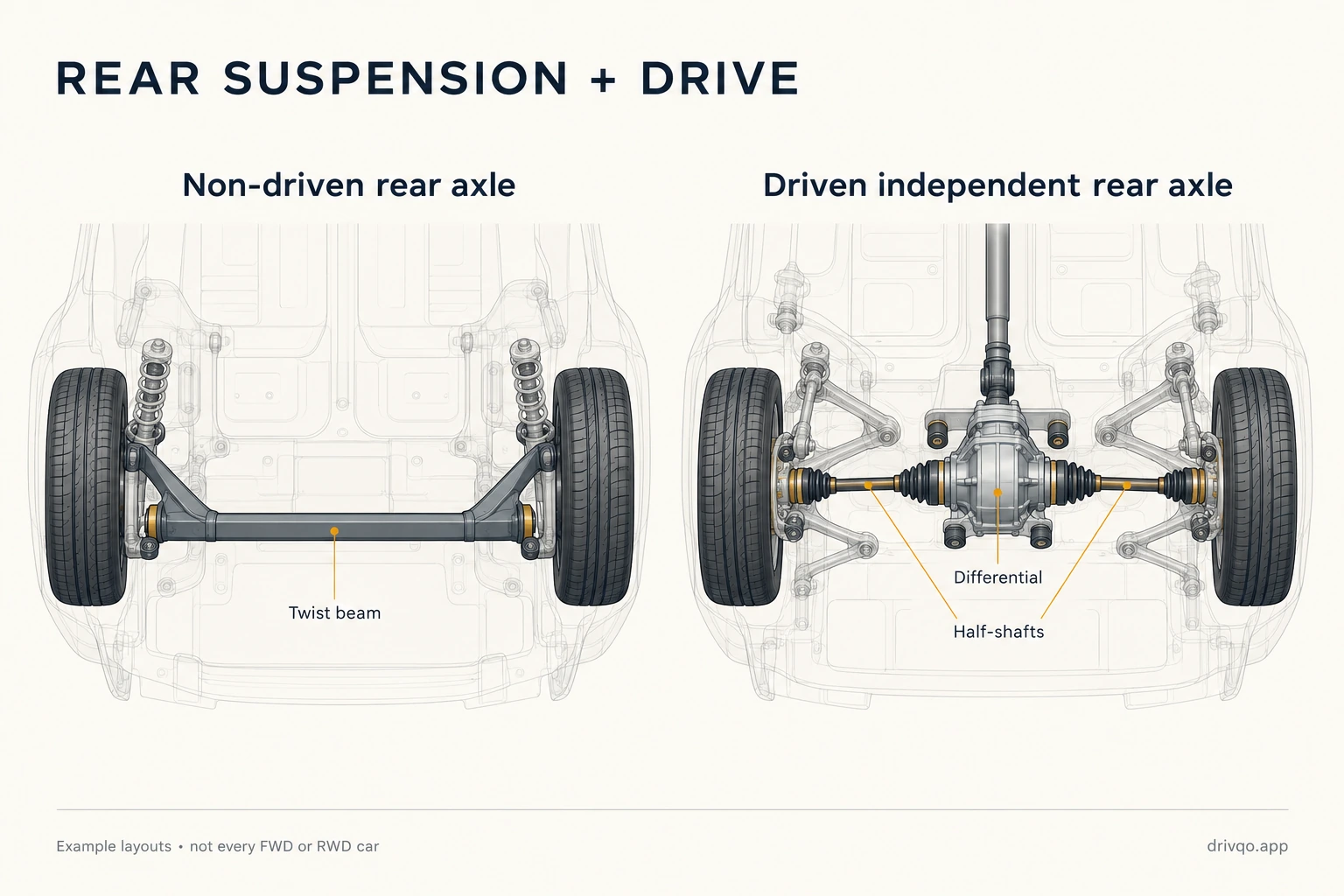
Two packaging examples, not a complete classification of rear suspensions. Component shapes are illustrative.
First separate the jobs
The suspension must locate each wheel while allowing useful movement relative to the body. It also carries braking and cornering forces and helps isolate road disturbances. Springs, dampers, links and bushes share those tasks; the label on the axle does not tell you its complete behaviour. ZF describes suspension as the connection between wheel and chassis and explains how several links can divide the wheel-location work. ZF Aftermarket, Multi-Link Suspension Systems
An independent layout lets the wheels move without a rigid axle housing directly fixing their relationship. It does not mean there is no connection between them: an anti-roll bar can still couple their motion. Our sway-bar explainer follows that particular connection.
What changes when the rear wheels are driven?
A conventional driven independent rear axle needs a final-drive unit and a route for torque to reach both wheel hubs. With the differential mounted to the body or subframe, articulated half-shafts accommodate wheel movement. A live axle places the differential and axle shafts in an assembly that moves with the wheels instead. Dana supplies beam axles for both rear-wheel-drive and all-wheel-drive vehicles, with several differential options. Dana, Light Vehicle Beam Axles
This adds a packaging question to the suspension question: where can the drive unit, shafts, links, exhaust and body structure coexist? It is more precise to describe these required components than to announce that all independent RWD suspensions have a particular cost penalty. A defensible cost comparison would need actual designs, production volumes and a common costing basis.
A half-shaft also has to accommodate changing geometry. GKN explains that a plunging constant-velocity joint allows the effective shaft length to change as the suspension moves. Articulation handles angular movement; plunge handles the changing distance between the connected components. These are distinct requirements, even when one joint provides both. GKN Automotive, Constant velocity joints
Why manufacturers use different layouts in one model family
The seventh-generation Golf's launch material describes a lightweight rear suspension for engines below 90 kW and discusses tuning its transverse member and trailing-link behaviour. The threshold differs from the later Golf example above. This is a reminder to attach a generation and date to any specification. Volkswagen, The new Golf: running gear, 2012
More links give engineers more variables to work with, but also create more components and interfaces to package. A simpler layout can still be carefully tuned. Neither the number of arms nor the driven axle identifies a universal winner for comfort, grip or durability.
How to read a suspension specification
Ask three separate questions: which wheels are driven, what locates those wheels, and how the actual vehicle is tuned. Then look for the model year and variant. For the geometry vocabulary, our double-wishbone versus MacPherson guide explains why component arrangement matters more than a prestige label.
Illustration: AI-generated and checked against the explanation. Conceptual only; sources are linked beside the relevant claims.