Double wishbone vs MacPherson strut: geometry and trade-offs
Double wishbone suspension locates the wheel with upper and lower arms. A conventional MacPherson layout uses a lower arm and a structural strut. The different arrangements give engineers different packaging and wheel-control options. Neither name, by itself, proves that a car rides or handles better. ZF describes multiple variations within each basic suspension family. ZF, independent suspension overview
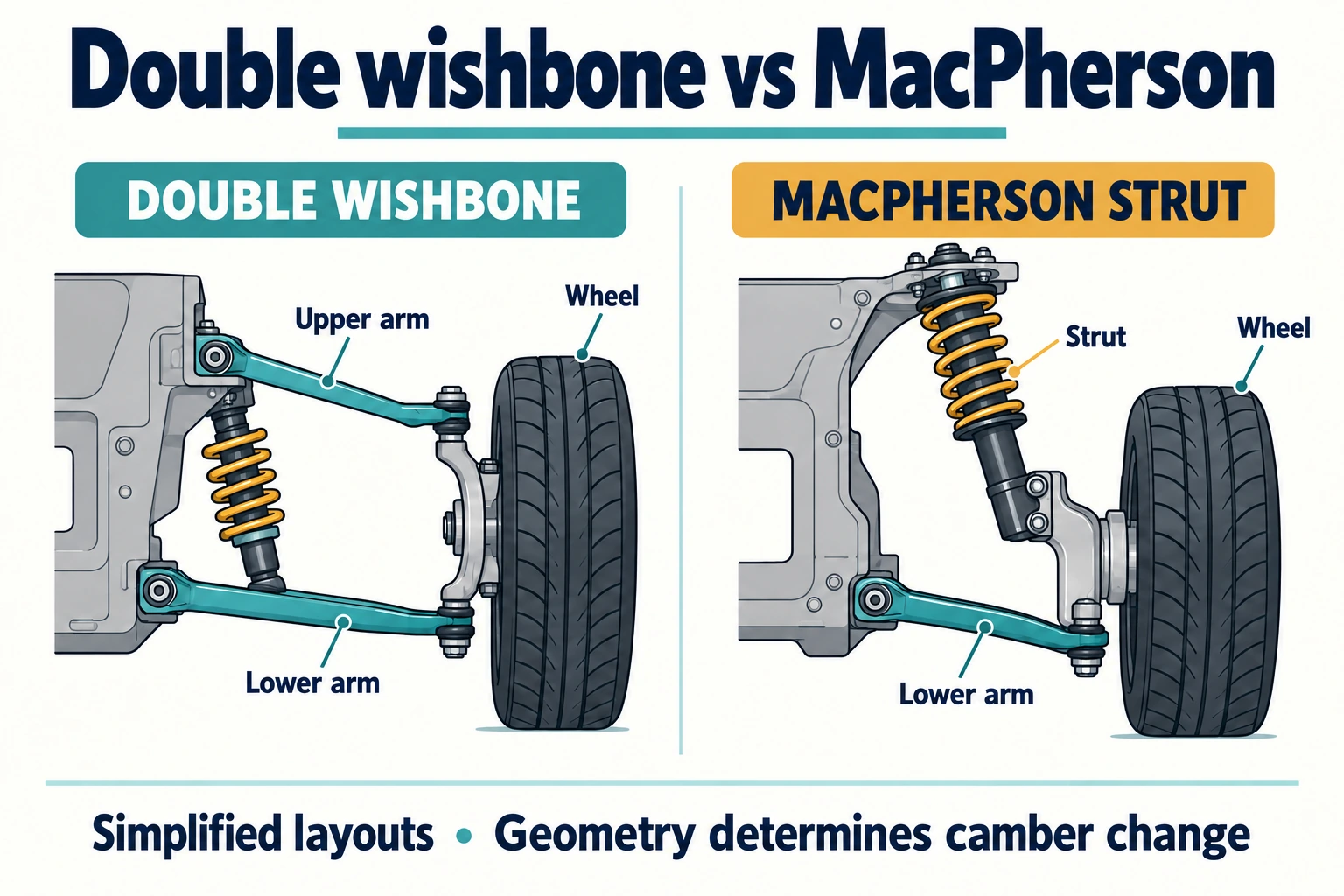
Layout sketch only. Arm angles and pivot positions are illustrative; no camber curve is being claimed.
What the suspension has to control
The suspension connects the wheels to the chassis while allowing movement over uneven roads. It must transmit driving, braking and cornering loads as well as manage vertical movement. Wheel location and isolation from road disturbances are related tasks, but they are not interchangeable. ZF, suspension functions
When comparing layouts, separate the spring and damper, which influence how movement develops, from the locating geometry, which helps determine the wheel's path and orientation. In a MacPherson system, the strut also forms part of that wheel-locating structure.
This structural role matters. Turini and Vannucci's SAE paper examines MacPherson design and how bending flexibility can affect camber and handling. It describes the layout as a useful solution for front-wheel-drive vehicles while analysing its structural compromises. Only the public abstract is used here. SAE 973067, Design Characteristics of McPherson Suspensions
Why camber appears in every comparison
Camber is the wheel's inward or outward tilt when viewed from the front. Engineers care about how that tilt changes as the suspension moves and as forces deform the components.
A double-wishbone layout gives the designer upper and lower locating arms to position. A MacPherson layout ties more of the wheel-location geometry to the strut and its top mount. ZF identifies reduced flexibility in camber and steering-axis setup among the constraints of conventional MacPherson designs. ZF, basic suspension types
However, the existence of an upper arm does not specify a camber curve. Its length, angle and mounting locations still have to be selected. Zhang and Yu's SAE design paper treats double-wishbone suspension as a multi-objective design exercise involving geometry, comfort and strength, rather than a single automatic improvement. SAE 2008-01-1836, public abstract
A production example: Porsche 911 GT3
Porsche's description of the 2021-generation 911 GT3 explains why it adopted a double-wishbone front axle. The company identifies increased camber stiffness under high compression and reduced lateral loading of the dampers as benefits of its design.
That is useful evidence because it connects a named layout to a named vehicle and specific engineering aims. It is not a controlled comparison proving that every double-wishbone car has more grip than every strut-equipped car. Porsche's tyre choices, joints, spring rates and the rest of the chassis remain part of the vehicle. Porsche, 911 GT3 product highlights, front suspension
Packaging and manufacturing also count
A suspension has to fit inside a body and work with the vehicle's structure. A 1975 Toyota engineering comparison assessed front-body constructions associated with different suspension types, considering weight, productivity, noise and vibration, and crash behaviour. It preferred MacPherson construction within its specific small-car study.
That historical result should not be used as a modern universal ranking. Its value is the reminder that engineers optimise the whole vehicle against several criteria. Wada and Inove, SAE 750076, abstract
| Useful comparison | What to look for |
|---|---|
| Wheel geometry | Camber and toe behaviour over the actual travel range |
| Structural behaviour | How joints and components deflect under load |
| Packaging | Space for body structure, steering and driven half-shafts |
| Ride and handling | Evidence from the complete vehicle, not arm count |
When a specification sheet says “double wishbone,” read it as information about the design tools available to the engineer. To judge the result, you still need evidence about the particular car.
Illustration: AI-generated and checked against the explanation. Conceptual only; sources are linked beside the relevant claims.