Limited-slip differentials: the mechanism and the history we can document
A limited-slip differential allows different wheel speeds while resisting unrestricted differential action. Depending on its design, it can deliver more torque to the side able to use it than an ideal open differential could in the same low-traction situation. It is not simply a device that makes both wheels turn at one speed. Eaton, What is a limited-slip differential?
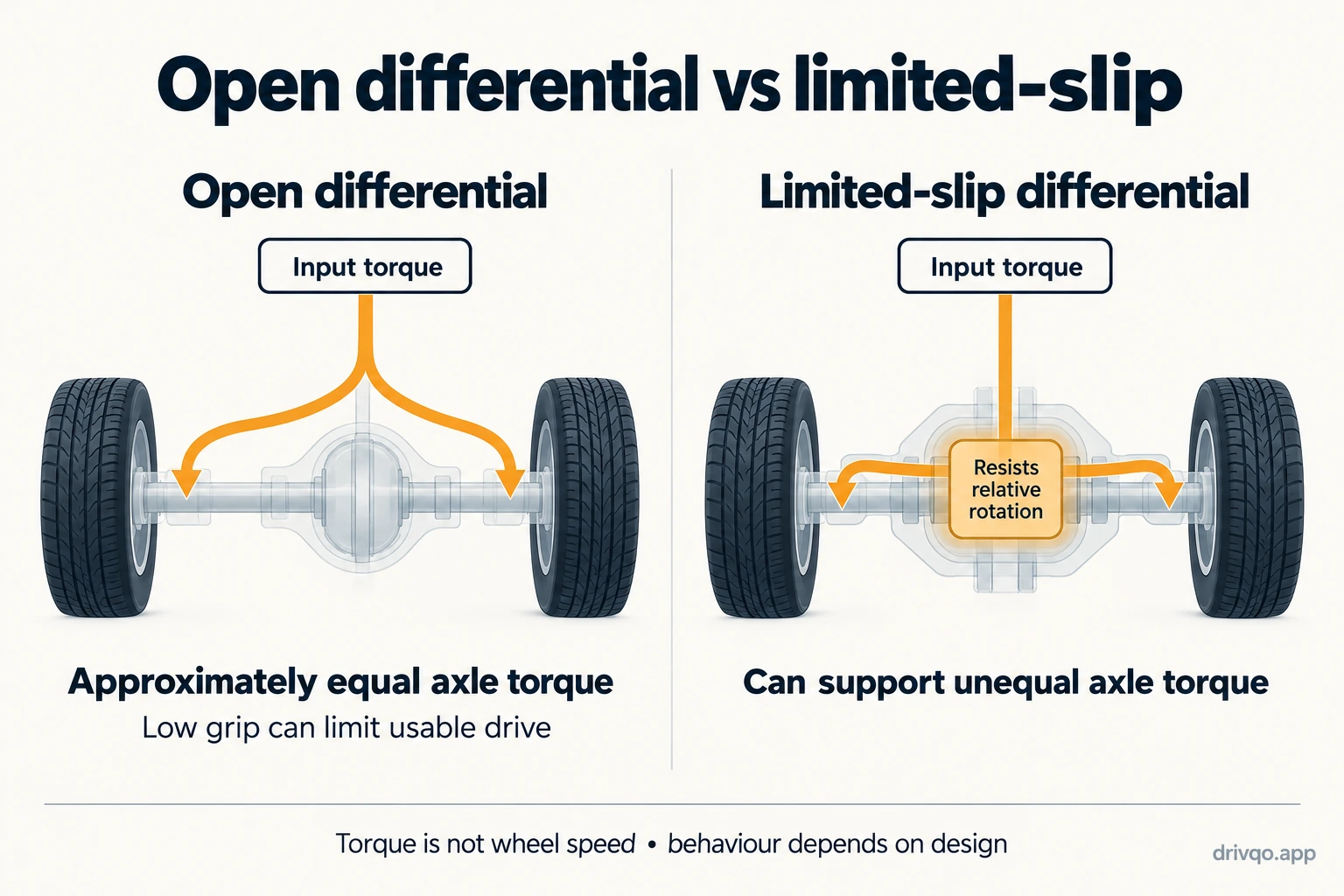
Functional relationships, not the internal geometry of a particular ZF or Eaton unit.
Why a car needs differential action
The two wheels on an axle follow different paths through a corner. A differential accommodates that difference rather than forcing both tyres to cover the same distance at the same rotational rate. ZF explains this purpose in its history of the Porsche relationship. ZF, 75 years of Porsche sports cars, 2023
The problem arises when available traction is very different on the two sides. Eaton distinguishes the approximately balanced wheel torque of an open differential from the torque bias possible with an LSD. Wheel speed and torque must remain separate concepts: a quickly spinning wheel is not necessarily receiving the most torque. Eaton, Limited Slip Differentials
Two mechanisms, one broad purpose
In a clutch-type design, friction plates resist relative movement. Eaton's Posi documentation describes clutch packs behind the side gears, spring preload and increasing clutch reaction as torque is applied. The friction interfaces create a controlled resistance; they do not make the assembly a rigid axle under every condition. Eaton, Performance Differentials Owner's Manual, Posi section, p. 19
In Eaton's helical-gear Truetrac, gear-generated forces provide the torque-biasing action. The name LSD therefore covers more than one internal architecture. A diagram of clutch plates should not be labelled as the mechanism of every limited-slip unit. Eaton, Limited Slip Differentials: Detroit Truetrac
Our wet-clutch article explains why friction material and lubricant are part of the design, although differential and transmission clutch specifications are not interchangeable.
What the Porsche–ZF record says
ZF dates its close relationship with Porsche to the 1930s and describes a ZF self-locking differential being considered for the Type 114 design. It also specifically identifies a ZF limited-slip differential in the later Type 550 Spyder. Those statements support a broad development history and named applications. They do not establish the precise claim that Porsche commissioned ZF in 1935. ZF, 75 years of Porsche sports cars: early cooperation and Type 550
That exact year remains outside the verified account here. A later application is not proof of the date of an earlier commission.
Limited slip is also not a promise of unlimited traction
Eaton notes that an LSD's available torque bias is limited; complete loss of traction at one wheel can still prevent some systems from moving the vehicle. Preload, mechanism and operating conditions matter. This is why “LSD,” “locking differential” and “traction control” should not be treated as interchangeable labels. Eaton, Limited Slip Differentials: limitations
An axle differential also solves a different location problem from an AWD centre differential. Our planetary centre-differential guide follows the front-to-rear connection.
Illustration: AI-generated and checked against the explanation. Conceptual only; sources are linked beside the relevant claims.