Wet vs dry clutches: friction materials, cooling and trade-offs
A wet clutch operates with oil at its friction surfaces; a dry clutch is designed to engage without an oil bath at those surfaces. Both transmit torque by pressing friction surfaces together. The oil changes how a wet clutch handles heat and how its friction material must behave. It does not make one type universally better. Schaeffler, Double Clutch symposium paper
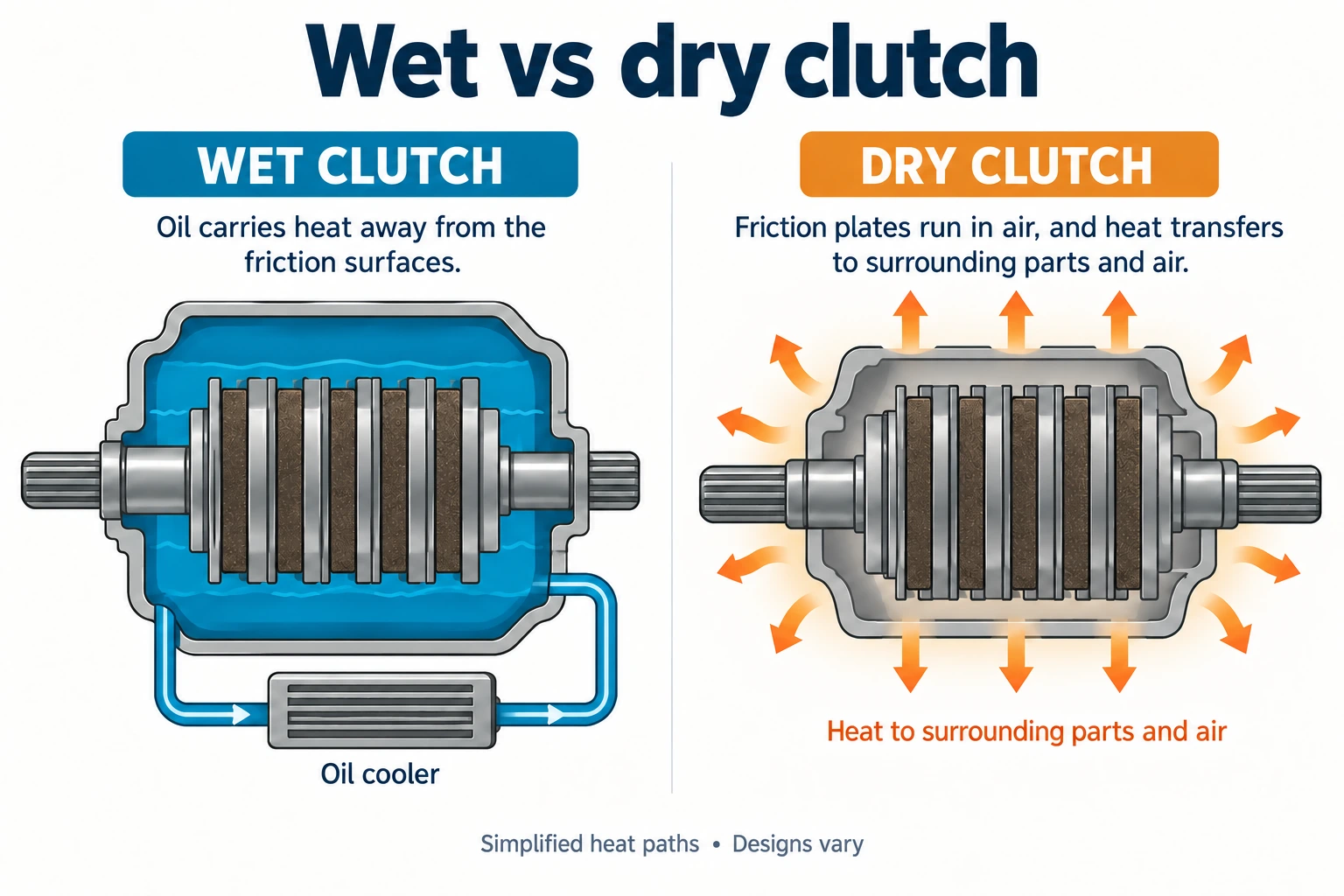
Conceptual heat paths. Plate counts, oil circuits and cooling arrangements vary.
Why a slipping clutch creates heat
A clutch connects two rotating parts. During engagement they may turn at different speeds, so the friction surfaces slide against one another while transmitting torque. Once engaged without slip, that sliding process stops.
In a multi-plate design, alternating plates connect to the two sides of the clutch. Applying force brings their friction surfaces together. Designers can change the number of interfaces, their dimensions, the lining and the applied pressure to meet the required torque and thermal duty. BorgWarner's technical paper describes these as parts of a combined design problem, rather than independent ways to make a clutch “stronger.” BorgWarner, High-performance Friction Elements for Automatic Transmissions
What oil does in a wet clutch
Oil carries frictional heat away, but it also becomes part of the contact system. The lining, mating metal and lubricant have to work together. Too much separation by oil can prevent the desired friction behaviour; too little oil can compromise cooling and contact conditions. Grooves and lining porosity help manage its distribution.
Oil also produces drag when components move relative to one another, including when a clutch is open. This explains why wet-clutch development involves both cooling performance and reducing unwanted losses. Schaeffler, Friction Tailored to Your Requirements, wet-lining section
Does a wet clutch really contain paper?
Some wet-clutch linings are paper-based friction composites. That description refers to an engineered material and its manufacturing route, not ordinary writing paper placed between metal plates.
A published Schaeffler patent application describes paper-based rings used in oil-submerged clutch applications and a papermaking process for producing the material. It establishes a concrete example of this material family; a patent is not evidence that every wet clutch uses the same formulation. WO2021202334A1, background and material description
Yu and colleagues studied paper-based and copper-based friction materials in a 2019 materials paper. Their discussion includes the roles of fibres and resin in the paper-based sample. Crucially, their comparative pin-on-disc tests ran under dry conditions. The results should not be presented as a wet-clutch lifespan comparison or used to promise how long a production transmission will last. Yu et al., Materials 12(18), 2988
Why use a dry clutch?
A dry design avoids the need to circulate cooling oil through its friction interfaces. Its thermal capacity and paths for shedding heat still have to suit the vehicle. Schaeffler's engineering comparison treats torque, vehicle mass, launch gearing, packaging and cooling as relevant selection factors. A wet arrangement can accommodate demanding thermal duties through its oil system; a dry arrangement can be attractive where its thermal envelope is sufficient. Schaeffler, Double Clutch
| Question | Wet clutch | Dry clutch |
|---|---|---|
| What is at the friction interface? | Designed supply of oil | No designed oil bath |
| How is heat managed? | Plates plus an oil-cooling path | Thermal mass and heat transfer to surroundings |
| What needs careful matching? | Lining, mating plates, fluid and flow | Lining, mating parts and thermal duty |
| Is lifespan fixed by the label? | No | No |
The comparison describes architecture, not a reliability ranking.
What the name does not tell you
“Wet” does not specify the number of gears, and “dry” does not mean that an entire transmission contains no lubricant. Volkswagen's DSG overview describes both wet and dry clutch versions within its transmission family. The exact gearbox matters. Volkswagen, Dual-clutch gearbox DSG
When comparing cars, identify the transmission code and consult its maintenance requirements. Cooling layout and material choice explain the design; they cannot, on their own, establish a service interval or a guaranteed lifespan.
Illustration: AI-generated and checked against the explanation. Conceptual only; sources are linked beside the relevant claims.