Planetary centre differentials: how AWD shares torque
A centre differential connects a drivetrain to its front and rear axles while allowing those axles to rotate at different speeds. Some designs use planetary gearing and can have an unequal normal torque split. For a documented example, Audi described a planetary centre differential with a normal 40% front and 60% rear split in its 2019 A4 45 TDI with eight-speed tiptronic. That is an application-specific specification, not a rule for all AWD vehicles. Audi, 2019 A4 drive and suspension
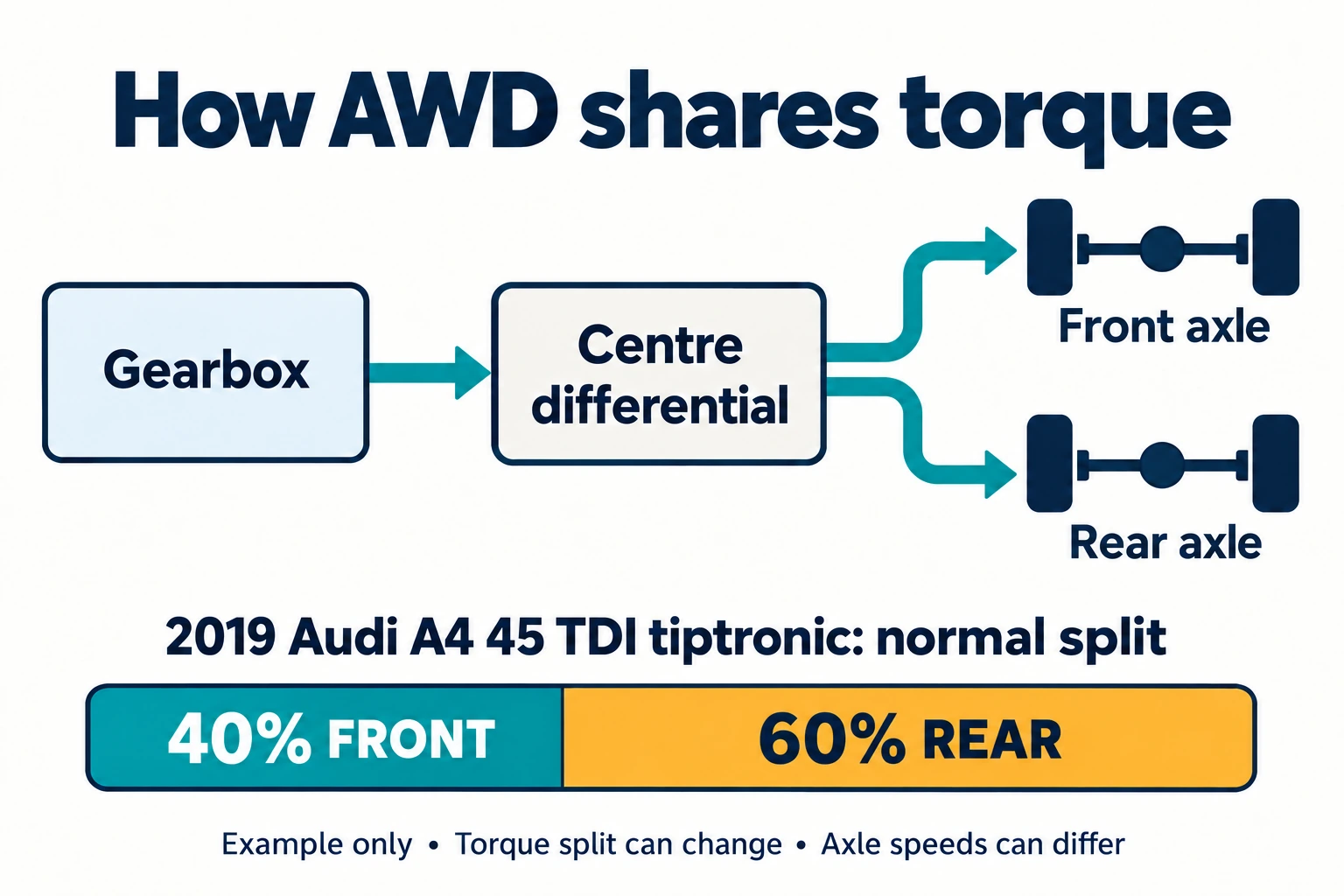
Functional diagram, not a cutaway of Audi's internal gear arrangement.
What makes a gearset planetary?
A basic planetary gearset contains a central sun gear, an internally toothed ring gear, and planet gears carried between them. A carrier supports the planet axes. The sun, ring and carrier form three mechanical connections whose speeds are related by the gear geometry.
For an ideal simple planetary set, the relationship can be written:
(Ns + Nr) × carrier speed = Ns × sun speed + Nr × ring speed
Here, Ns and Nr are the sun and ring tooth counts, with all speeds expressed using a consistent sign convention. MathWorks documents this kinematic relationship in its planetary-gear model. MathWorks, Planetary Gear
You do not need to calculate it to understand the point: the members are related, but they do not have to turn at identical speeds. A planetary set can therefore do more than provide one fixed reduction. How it is connected determines its role. The equation above describes a simple ideal set; it is not a reverse-engineered model of the Audi unit.
Speed difference and torque split are different questions
A speed relationship describes how fast parts rotate. A torque split describes how twisting effort is shared. Confusing the two leads to statements such as “60% rear torque means the rear wheels rotate 60% faster,” which does not follow.
Ask three separate questions when reading an AWD description:
- Which components connect to the front and rear outputs?
- What is the normal torque distribution?
- What mechanism changes that distribution or limits relative motion?
The simple planetary model supplies kinematic constraints. A real self-locking differential also involves friction and load-dependent behaviour, so its operation is not fully described by a tooth-count equation. MathWorks model scope, Audi TechDay quattro, self-locking centre differential
How self-locking changes the picture
Audi's technical explanation describes helical gearing that generates axial forces acting on friction elements. Those forces contribute to the differential's locking effect and change how torque is distributed. This is a mechanical response to the drivetrain's loading conditions; it should not be explained as a computer simply choosing an arbitrary percentage for an otherwise open gearset. Audi TechDay quattro, 2017, p. 7
For the 2019 A4 application, Audi specified that the distribution could reach up to 70% at the front or 85% at the rear when needed. These are alternative limits, not percentages to add together. The normal 40:60 split is the baseline described for that system, rather than an unchanging command. Audi, 2019 A4
Why the AWD badge is not enough
The same A4 press material describes a different arrangement for versions using quattro with ultra technology: a controlled clutch system manages engagement of the rear driveline. It would be incorrect to transfer the planetary-centre-differential description to those versions merely because both carry the quattro name. Audi, transmission and AWD variants
A useful drivetrain explanation therefore names the model, transmission and generation. “AWD” tells you which wheels can be driven; the hardware description tells you how the system accommodates speed differences and distributes torque.
The planetary layout is one solution to that engineering problem. Its flexibility comes from the relationships between multiple rotating members, while its real behaviour depends on the complete differential and drivetrain design.
Illustration: AI-generated and checked against the explanation. Conceptual only; sources are linked beside the relevant claims.