Before electronic fuel injection: three milestones that explain the change
Fuel injection did not begin with electronic engine management. Mechanical pumps delivered gasoline to engines before electronic control became a mass-production proposition. The history becomes easier to follow when the injection location and the method of control are treated as separate facts.
Bosch's history documents automotive gasoline-injection production in 1951, a 1954 high-performance application in the Mercedes-Benz 300 SL and the arrival of electronic Jetronic in 1967. These are bounded milestones in Bosch's story, not a complete account of every earlier experiment. Bosch, The history of gasoline injection
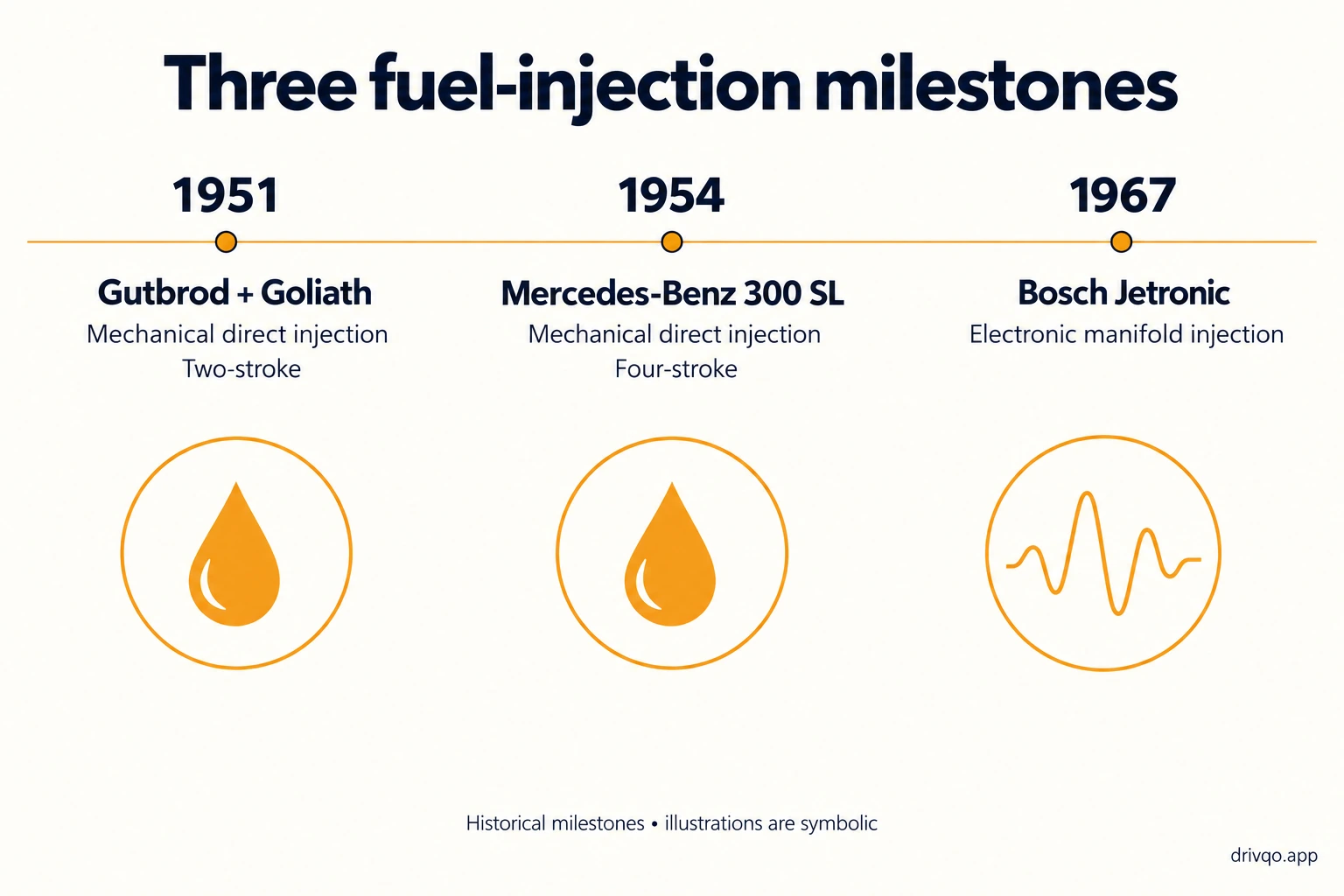
A selected passenger-car timeline. It does not identify the first fuel-injection experiment in all engine categories.
Two questions to ask about any injection system
First, where does the fuel enter? With port injection, the injector sprays upstream of the inlet valve and the mixture enters through that valve. With direct injection, the fuel enters the combustion chamber itself. Bosch's port-injection description makes the location explicit. Bosch Mobility, Gasoline port fuel injection: operating principle
Second, how is delivery controlled? “Mechanical” and “electronic” refer to the control arrangement, not necessarily the injector's location. Thus an early direct-injection system can be mechanically controlled, while an electronic system can inject into the manifold. Treating “direct” as a synonym for “computer-controlled” collapses two different design choices.
1951: a small-car application
Bosch identifies Gutbrod as its first customer for the new passenger-car system, followed by Goliath. These applications used two-stroke engines. Bosch describes direct injection as a way to reduce fuel loss associated with the earlier carburetted arrangement. The modest vehicle category matters: the story was not exclusively about expensive sports cars. Bosch, The history of gasoline injection: first customers and a new beginning
1954: the Mercedes-Benz 300 SL
The 300 SL gave mechanical gasoline injection a prominent four-stroke passenger-car application. Bosch's historical education material distinguishes that four-stroke milestone from the earlier two-stroke installations. It should not be rewritten as “the first fuel-injected engine,” which would erase the earlier categories. Bosch, Igniting Minds: Gasoline injection
1967: electronic control reaches series production
Bosch dates the Jetronic public presentation to 14 September 1967 at Frankfurt. Its development account describes earlier prototypes and Volkswagen's need to meet tighter emissions requirements. The later name D-Jetronic identifies this early electronic approach; the important transition here is control of fuel delivery through electronics. Bosch, The gasoline injection Jetronic: prototypes and launch
A modern injector should not be used as a literal illustration of a 1951 pump. The shared purpose is metering fuel, but the components and control strategies differ.
What remains outside this timeline
The often-repeated claim about Deutz manifold injection in 1898 needs a source identifying that particular fuel system. Deutz's own history discusses early diesel development, but that is not proof of a gasoline manifold-injection claim. This article therefore does not include the 1898 assertion as an established milestone. DEUTZ, Striking Heads: corporate history
When comparing engine technology, keep the application, fuel, injection location and control method together. For another example of why two related terms need separating, see turbo lag versus boost threshold.
Illustration: AI-generated and checked against the explanation. Conceptual only; sources are linked beside the relevant claims.