Turbo lag vs boost threshold: why a turbo takes time to respond
Boost threshold describes the operating conditions at which a turbo can produce useful boost. Turbo lag describes the time it takes to respond after you ask for more power. They can feel similar from the driver's seat, but they describe different things. Engine speed alone is not the whole story: load and exhaust energy also matter. Engineering Explained: Turbo Lag vs Boost Threshold
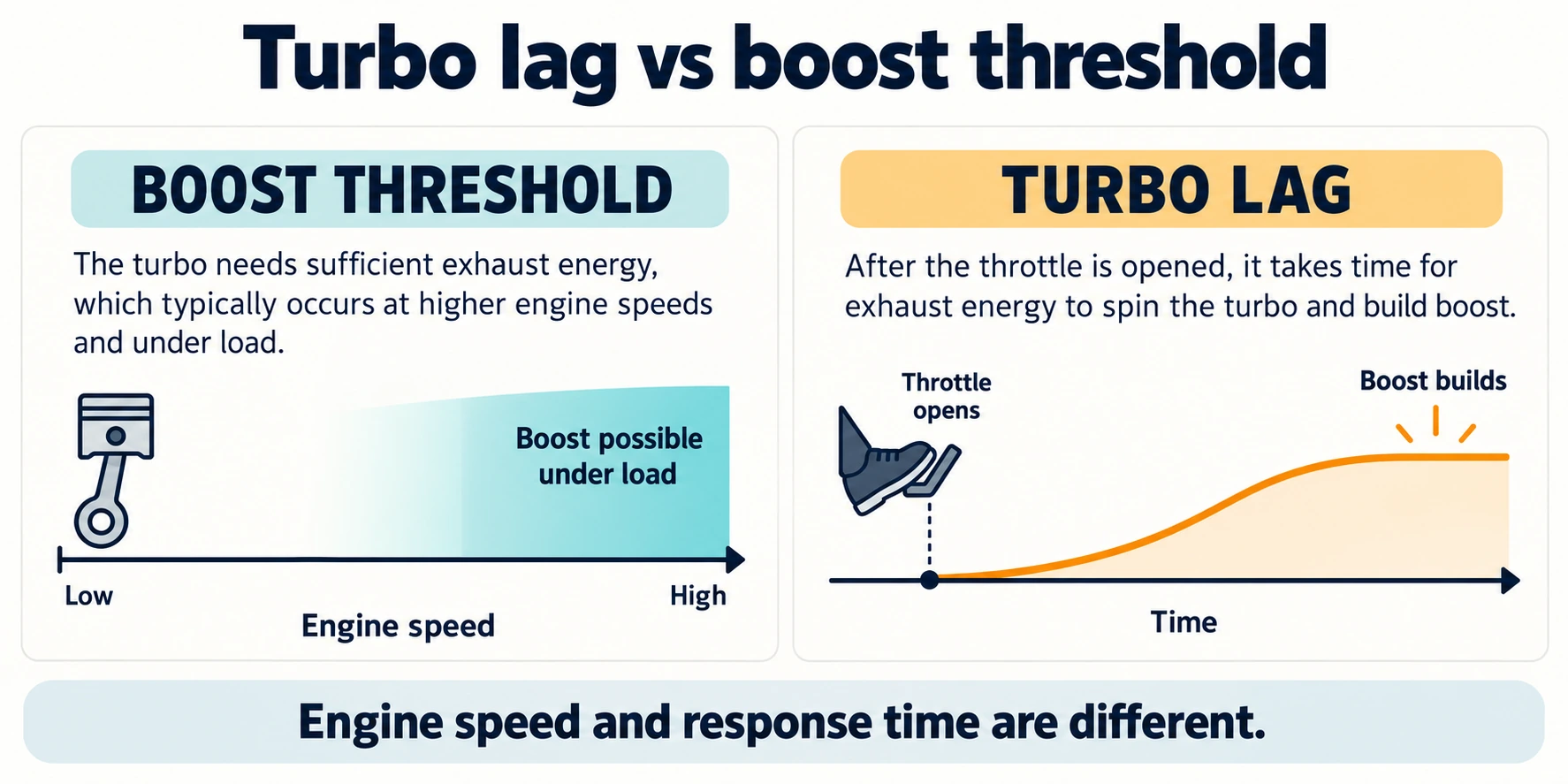
Illustrative curves, not measurements from a particular engine.
What happens when you press the accelerator?
A turbocharger connects an exhaust-driven turbine to an intake-air compressor through a shaft. Energy extracted from the exhaust drives the compressor, which supplies pressurised air to the engine. Increasing the requested engine output changes the airflow and exhaust conditions; the rotating assembly and the air system must respond before the new operating point is reached. Garrett's introductory guide explains this energy path. Garrett, Turbo Tech 101
Think of two different questions:
- Can this engine produce the requested boost at this operating point? That is the threshold question.
- How long does it take to reach that boost after the request changes? That is the response-time question.
If the engine is operating below the conditions needed for the requested boost, waiting longer at that same operating point will not necessarily produce it. Conversely, an engine already capable of generating boost can still take time to respond to a sudden demand. This is why quoting a single “turbo kicks in at X rpm” figure often leaves out the useful detail. Engineering Explained
Why response is a system problem
The turbine needs energy to accelerate its rotating assembly and drive the compressor. Its response therefore depends on the available exhaust energy, the inertia of the rotating parts, and the work required by the compressor. Garrett describes electric assistance as a way to add shaft power during this transition; it can compensate for inertia that would otherwise slow the response. Garrett E-Turbo
There is also more to engine response than the turbo itself. The turbo has to be matched to the engine and its operating range. N. Watson's SAE paper identifies system matching and exhaust-energy utilisation as important issues in turbocharged-engine design. Its public abstract supports that system-level point; it does not establish a universal response improvement for any aftermarket modification. Watson, SAE 790063, abstract
Which changes can improve response?
A smaller turbo or turbine housing can favour earlier response. Garrett also describes the trade-off: a restrictive turbine side can raise backpressure at high flow, limiting the operating range that matters for peak output. Choosing the smallest possible turbo is therefore not an all-purpose solution.
Bearing design can reduce mechanical losses. Garrett reports faster response for its cartridge ball-bearing designs compared with its traditional journal-bearing arrangements. That supports the mechanism, not a promise that every ball-bearing turbo improves every car by the same percentage. Garrett, sizing and bearing sections
Electric assistance adds another energy source. An electrically assisted turbo uses a motor to help drive the shaft instead of relying entirely on the exhaust during the transient. This requires a compatible electrical system and controls; it is a different engineering solution from simply installing a larger conventional turbo. Garrett E-Turbo
Other arrangements, including variable turbine geometry and divided exhaust systems, deserve their own explanations. Their effectiveness depends on implementation. A list of technologies is not evidence that they all deliver the same result.
How to read a turbo-response claim
Ask what was measured. A steady-state torque curve shows output at operating points; a transient test records how output changes with time. A convincing comparison should specify engine speed, load, starting conditions, requested boost, gear and the response criterion.
For example, “reaches a chosen boost pressure sooner after a throttle step” is a testable statement. “Has no lag” hides both the starting conditions and the meaning of response. Treat the former as a claim that can be checked and the latter as wording that needs clarification.
The useful distinction is simple: threshold concerns whether boost is available under the stated conditions; lag concerns how quickly the system gets there.
Illustration: AI-generated and checked against the explanation. Conceptual only; sources are linked beside the relevant claims.