F-head and IOE engines: follow the two different valve paths
An intake-over-exhaust arrangement combines an overhead intake valve with an exhaust valve in the block. The Willys F4-134 is a well-documented F-head example. Its factory service manual explicitly distinguishes the pushrod-and-rocker-operated intake valves from the tappet-operated exhaust valves. Willys, Jeep Utility Vehicles Service Manual SM-1001-R1, 1959, section E-1, hosted transcription
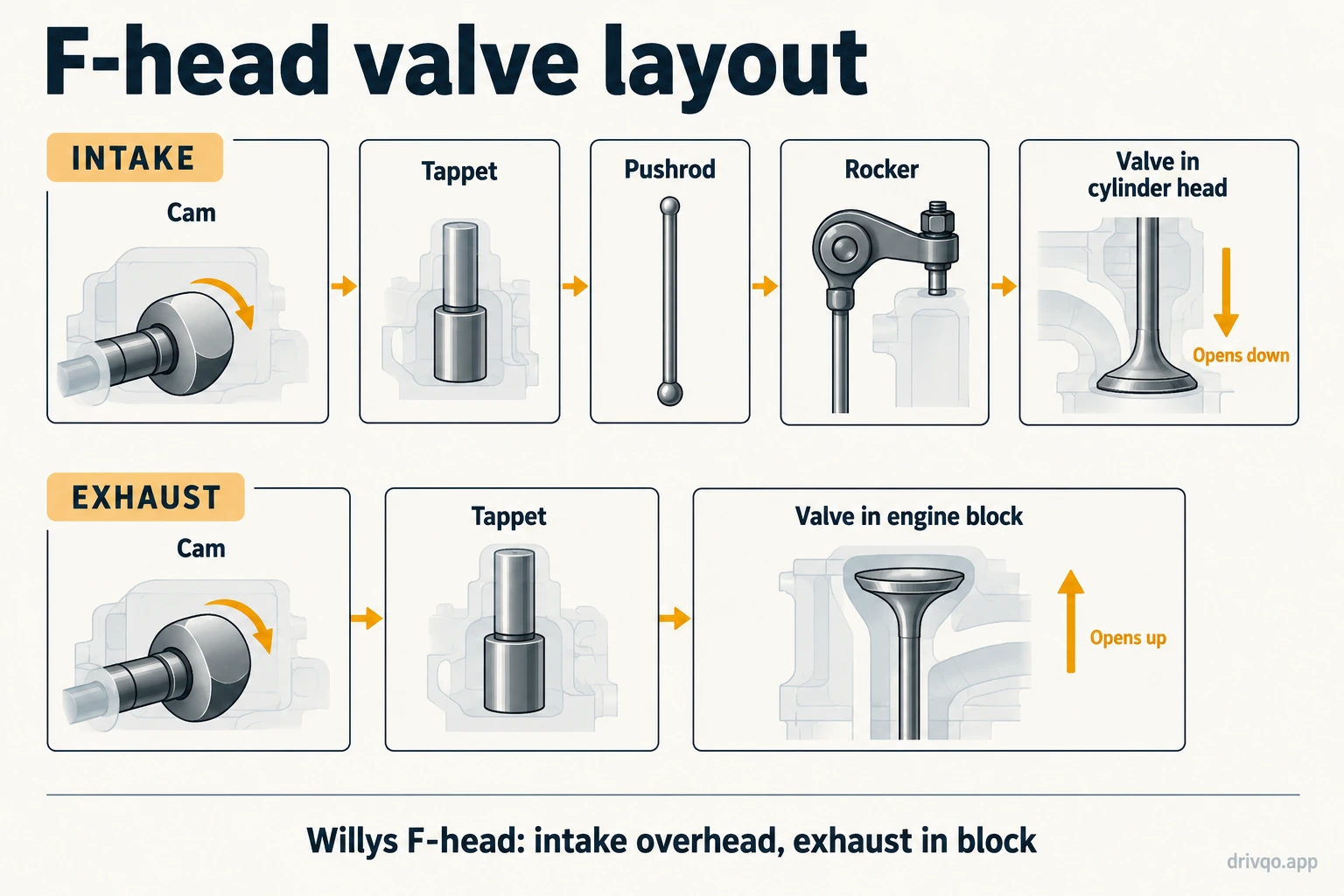
Component relationships only. Valve timing, clearances and dimensions are deliberately omitted; this is not an assembly or adjustment guide.
Trace the intake path
In the Willys arrangement, a cam-driven tappet moves a pushrod. The pushrod acts on a rocker above the head, which presses the intake valve open. The rocker redirects the movement: upward pushrod motion can produce downward valve motion. The valve spring closes the valve as the opening action subsides. The factory's end-view illustration identifies the rocker, pushrod, inlet valve and spring separately. Willys, section E, figure 97
Trace the exhaust path
The exhaust valve sits beside the cylinder in the block. Its tappet provides the opening action without the intake side's long pushrod and overhead rocker. In the illustrated upright arrangement, the exhaust valve opens upward into the chamber region. This describes the Willys layout; it should not be treated as a dimensionally exact drawing of every engine called IOE. Willys, section E-1 and figure 97
Compare valve location with camshaft location
Two different questions are easy to mix up: where is the valve, and what drives it? An overhead valve need not be driven by an overhead camshaft. Pushrods and rockers allow a camshaft lower in the engine to operate valves in the head.
Briggs & Stratton's maintenance explanation separates conventional valve access from overhead-valve service and identifies pushrods and rocker arms in its OHV procedure. It is a modern small-engine example of that actuation vocabulary, not a source for Willys settings. Briggs & Stratton, Small Valve Maintenance & Repair: overhead valves
| Layout term | What to look for |
|---|---|
| Side-valve / flathead | Valves beside the cylinder in the block |
| F-head / intake over exhaust | Intake in the head; exhaust in the block in the example here |
| Pushrod OHV | Valves in the head operated through pushrods and rockers |
Why the distinction is useful
When reading a cutaway, start at the cam and follow each mechanical connection. Do not assume that two valves shown near one cylinder share the same actuation path. The F-head is interesting precisely because its intake and exhaust paths differ.
The arrangement alone does not prove superior cooling, power or fuel economy. Those claims require a defined comparison between engines. For a separate kind of layout choice, our 2CV flat-twin article explains cylinder arrangement; “flat twin” and “F-head” classify different features of an engine.
Illustration: AI-generated and checked against the explanation. Conceptual only; sources are linked beside the relevant claims.