Cadence braking versus ABS: who is controlling the pressure?
Cadence braking describes repeated driver modulation of the brake pedal; ABS controls brake pressure electronically in response to wheel behaviour. The resemblance ends before the operating instructions begin. A driver should not imitate ABS by pumping the pedal in an ABS-equipped vehicle.
The UK Highway Code's rule 120 tells drivers of ABS-equipped vehicles to follow the handbook and, in an emergency, apply the footbrake firmly without releasing pressure until the desired speed is reached. It also warns against assuming ABS always shortens stopping distance. UK Highway Code, rule 120
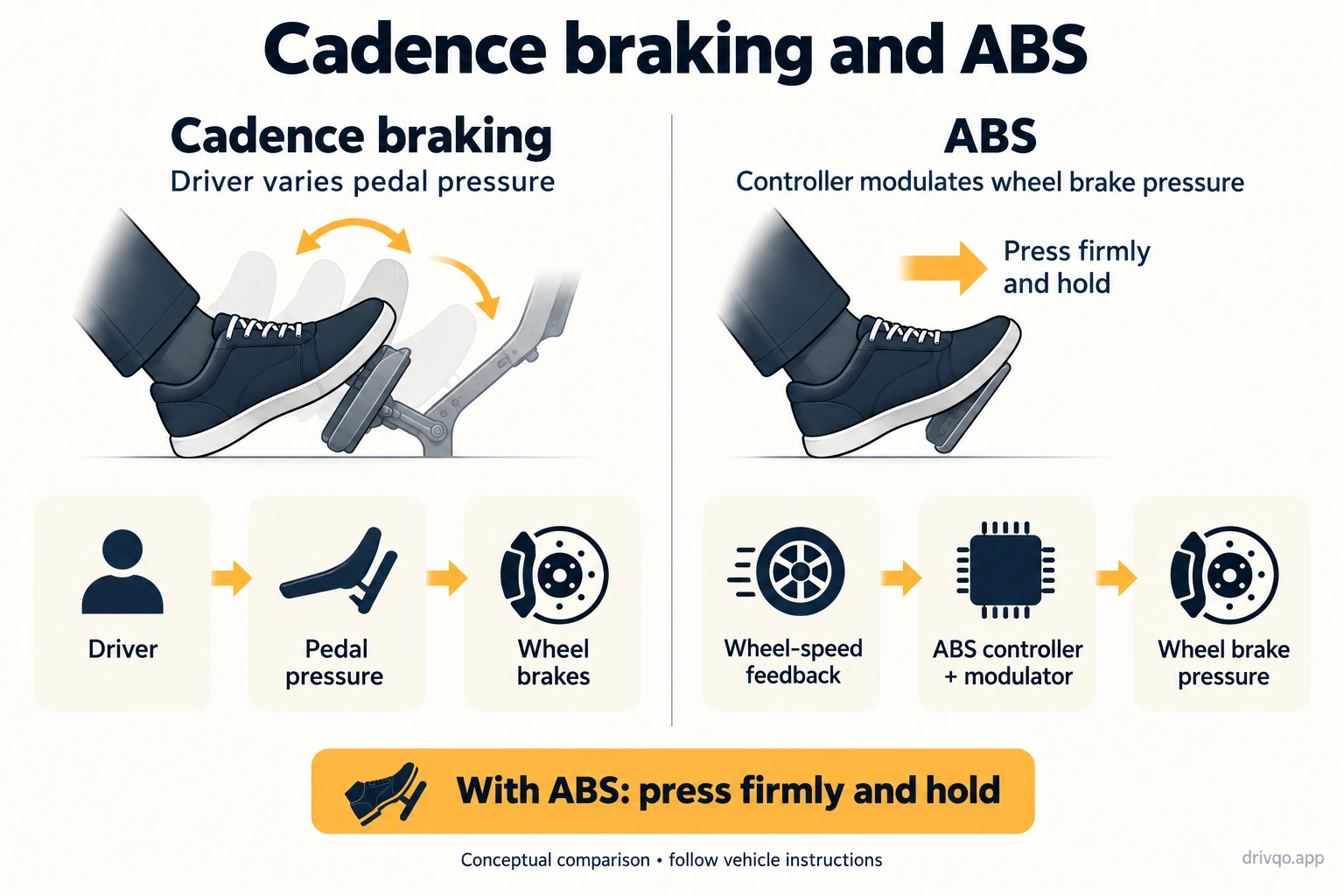
Control roles only. This is not a stopping-distance chart or a practical lesson in non-ABS emergency braking.
Why releasing pressure appears in both explanations
A wheel that is approaching lock can regain rotation when braking pressure is reduced. The distinction is who observes the condition, who makes the adjustment and where that adjustment is applied.
Bosch's ABS description identifies wheel-speed sensors, an electronic controller and a hydraulic unit containing valves and a return pump. The controller can reduce pressure at an affected wheel and build it again as the lock tendency changes. That is a feedback system operating on wheel information, not simply a repeated movement of the driver's foot. Bosch Mobility, Antilock braking system: operating principle
Pedal movement and wheel pressure are different signals
The driver's steady request and the hydraulic unit's changing pressure can coexist. That is why pulsation at the pedal does not necessarily mean the driver should release it. Ford's ABS guidance explicitly says the pedal may pulse or travel further and instructs the driver to maintain pressure. It also says ABS does not remove risks from excessive cornering speed, poor surfaces or following too closely. Ford, Hints on Driving With Anti-Lock Brakes
This separation between request and response is the key to the comparison. The driver asks for braking; the functioning ABS system manages pressure when needed to address lock tendency. Our full ABS guide follows the components in more detail.
Cadence is not the recommended ABS technique
A published military vehicle manual supplies an unusually explicit example of the terminology. Its ABS instructions say not to use cadence braking and describe that as repeatedly applying and releasing the footbrake. It instead requires continuous pedal pressure. Those instructions apply to the covered vehicle; the source is used here to establish the distinction, not to transplant a truck procedure into every car. UK Ministry of Defence, DROPS MMLC vehicle manual: ABS operating guidance
What is not established by this comparison
The sources above do not prove that modern stiff or heavily damped suspension makes a particular historic rally technique less effective. That narrower performance claim would need a defined vehicle, surface and test or published analysis. It is deliberately not repeated as fact here.
Likewise, there is no universal metres-saved figure in the diagram. ABS is a control system working within available tyre-road grip, not a way to remove the need for appropriate speed and distance. Follow the vehicle's own instructions, including its guidance when an ABS warning indicates the system may be unavailable.
Illustration: AI-generated and checked against the explanation. Conceptual only; sources are linked beside the relevant claims.