How ABS works: wheel-speed sensing and brake-pressure control
An anti-lock braking system monitors wheel rotation and adjusts brake pressure when a wheel tends to lock. Its purpose is to help preserve control during hard braking. It cannot create extra tyre grip or guarantee the shortest stop on every surface. Bosch documents the control mechanism; NHTSA's testing shows why surface-dependent qualifications matter. Bosch, ABS, NHTSA, Light Vehicle ABS Performance
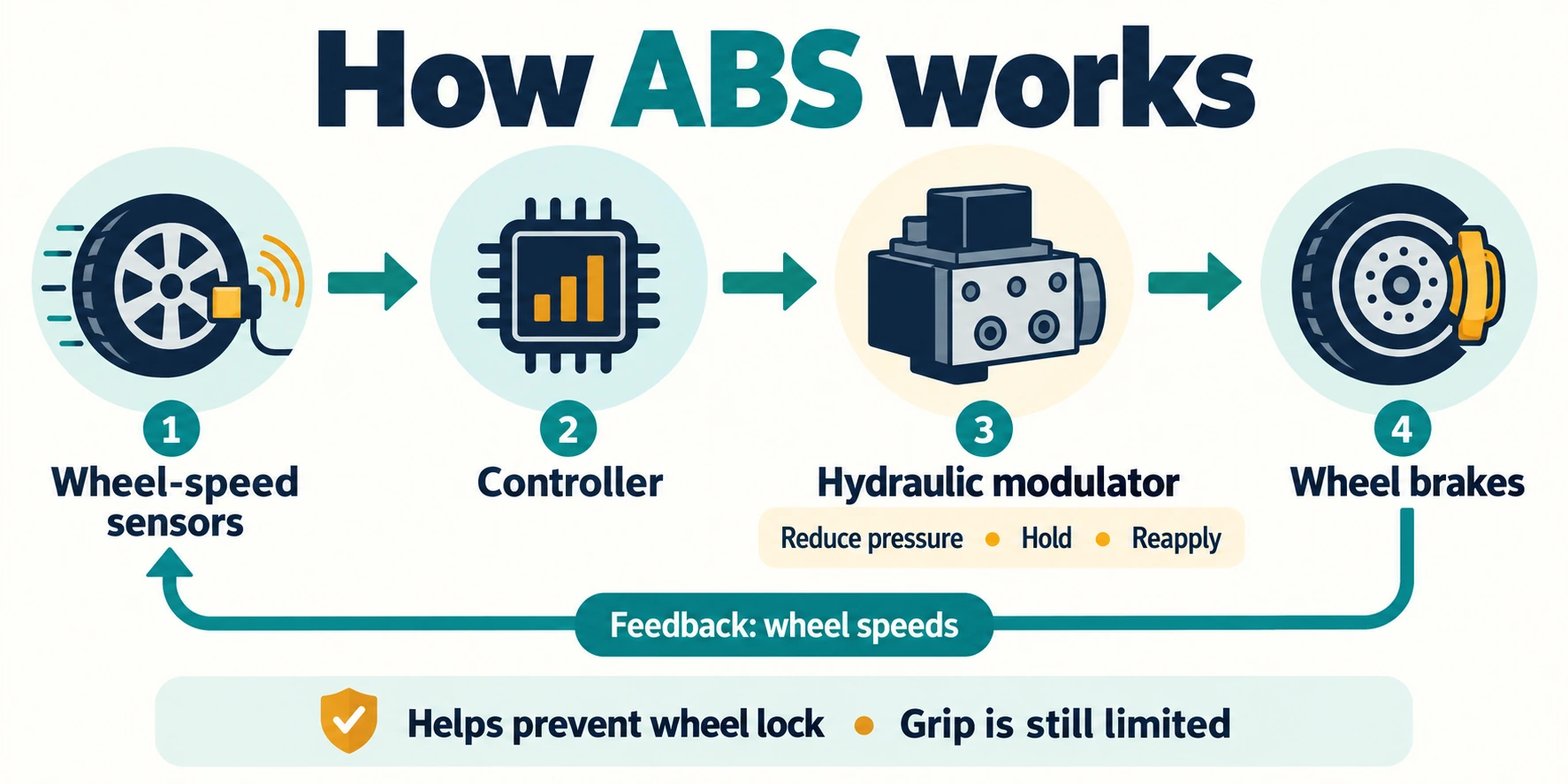
Functional feedback loop. The controller responds to wheel behaviour rather than applying one fixed pressure pattern.
Why a locked wheel is a problem
During braking, the tyre must generate forces against the road. If a wheel stops rotating while the car is still travelling, it is sliding rather than rolling normally. A locked front wheel substantially reduces the driver's ability to change direction through steering.
ABS manages the braking effort to help avoid that state. It does not steer around an obstacle for the driver, and its presence does not justify reducing the following distance. NHTSA's consumer guidance explicitly retains that need for space. NHTSA, ABS advisory
The hardware behind the pedal
In the four-wheel system described by Bosch, each wheel has a speed sensor. An electronic controller receives those signals. A hydraulic unit contains pressure-control valves and a return pump.
When a wheel tends toward lock, the system can reduce pressure at that wheel. Once the tendency passes, pressure can increase again. Because the system acts on wheel-brake pressure, the driver's continued pedal force does not require every wheel to receive unchanging pressure throughout the stop. Bosch, system components and operation
Reduce, hold and reapply
ABS operation is often explained through three hydraulic states: reduce pressure, hold it and reapply it. These are control actions, not a timetable that every car follows at the same rate. The controller keeps reassessing wheel behaviour as conditions change.
The Indiana Law Enforcement Academy's emergency-vehicle training manual describes these pressure phases. It is useful for the operating principle; its driving-training context should not be mistaken for a specification for every passenger-car ABS unit. ILEA, Basic Emergency Vehicle Operations manual
Pedal pulsation can accompany ABS activity, although the feel depends on the braking system. It reflects pressure modulation and associated hydraulic activity, not proof that the brakes have ceased working. Bosch
Does ABS always shorten stopping distance?
No. NHTSA's light-vehicle tests found longer stopping distances with ABS on the loose-gravel surface in that study. The report explains that a locked tyre can build up deformable material in front of it, generating a braking effect that a rolling tyre does not produce in the same way.
That does not make deliberate wheel lock a general driving recommendation. It shows that stopping distance and directional control are separate outcomes, and a system can trade between them on a particular surface. Results from one test programme should not become an exact percentage prediction for a different vehicle, tyre or road. NHTSA report, loose-gravel results, section 5.3
What should the driver do during ABS braking?
For a conventional four-wheel ABS emergency stop, Oregon's transport guidance advises firm, continuous brake pressure rather than pumping the pedal. The system performs the pressure modulation. Follow the vehicle's own manual for its specific instructions, especially where warning lights indicate a fault. Oregon DOT, Anti-Lock Brakes
The useful technical distinction is between requesting braking and controlling individual wheel pressure. The driver supplies the request; ABS adjusts pressure to manage wheel lock. Tyres, road conditions and speed still determine the physical limits.
For electric vehicles, there is another layer: coordinating electrical and friction braking. See how regenerative braking works.
Illustration: AI-generated and checked against the explanation. Conceptual only; sources are linked beside the relevant claims.