Crosley, Jaguar and the early story of disc brakes in racing
The early racing history of disc brakes is clearer when three things stay separate: the event, how its winner was determined and the brakes fitted to the actual car. Sebring in 1950 and Le Mans in 1953 are both important, but they are not interchangeable milestones.
Sebring's own timeline dates its first race to 31 December 1950 and identifies it as a six-hour event. The first 12 Hours of Sebring followed in 1952. Calling the 1950 race a 12-hour victory is therefore a basic chronological error. Sebring International Raceway, Track History
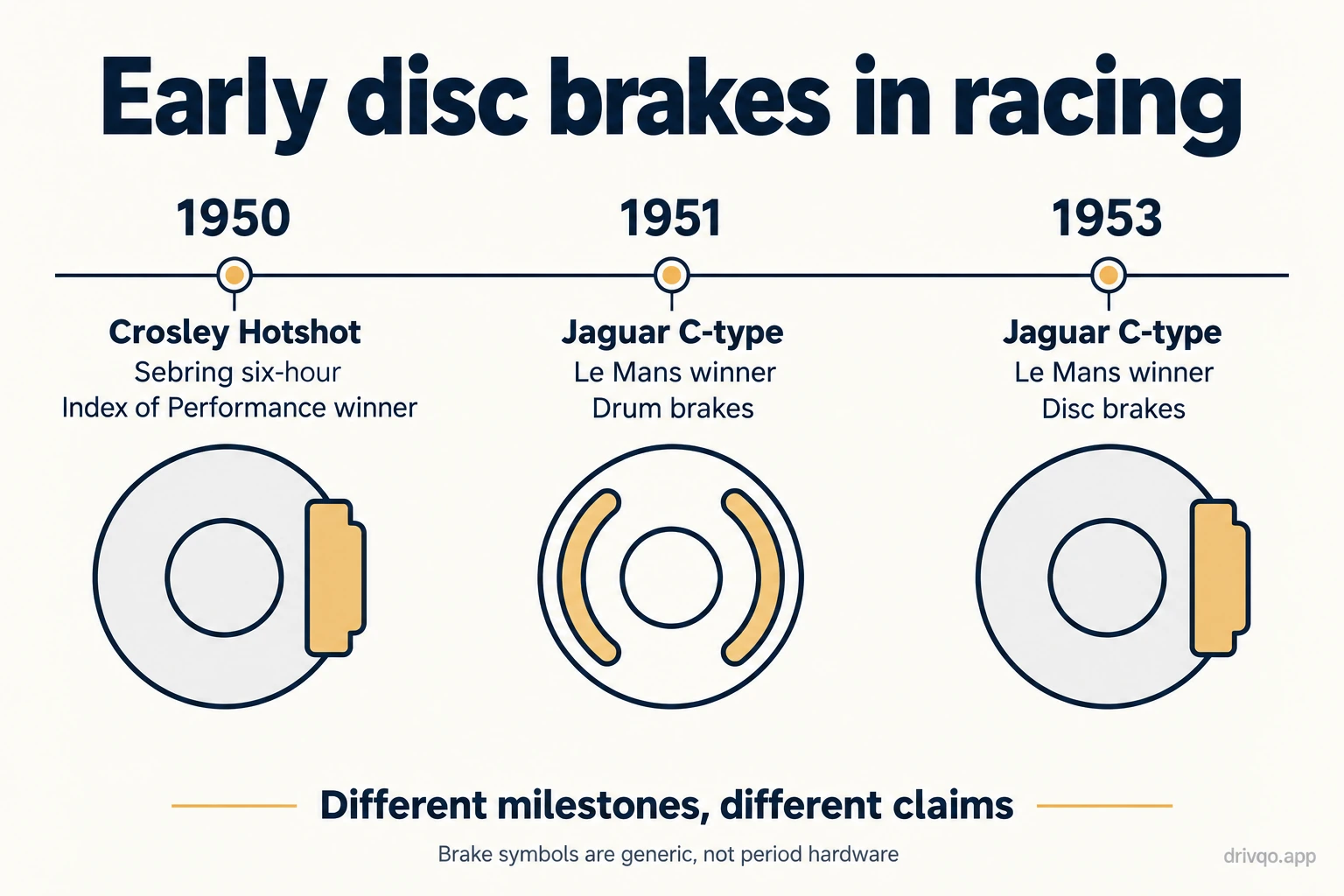
Selected milestones, not a claim to identify the first disc brake ever built or used in competition.
What the Crosley result means
Sebring identifies Frits Koster and Ralph Deshon's Crosley Hot Shot as the winner of the inaugural Sam Collier memorial race. The event's handicap context is essential to interpreting that result. Sebring International Raceway, historical background in its 2025 appointment announcement
The Crosley Automobile Club preserves an account explaining the Index of Performance: the required distance depended on the car's engine category. Its narrative describes the Crosley leading that index despite being among the slower cars on the circuit. This supports describing an index-based victory, not claiming the Crosley covered the greatest outright distance. Crosley Automobile Club, Forgotten History: The First Sebring Race
The brake specification needs its own evidence
The club's technical archive reproduces information attributed to Crosley sales letter S-8 of 25 September 1950. It records the change to Bendix brakes in June 1950 and states that four-wheel discs had been used from mid-1949 until the change. This is useful production context, but production chronology alone does not prove the equipment fitted to one race entry. Crosley Automobile Club, Brakes: When Were 9-inch Bendix Brakes Used?
Consequently, this article does not assert that the Sebring car's four discs were inspected and verified as stock. That exact combination of chassis, event and equipment needs entry-specific documentation. Keeping that limit visible is better history than joining two plausible facts into an unsupported certainty.
Jaguar's 1951 and 1953 cars were not the same brake specification
Jaguar describes its 1951 Le Mans-winning C-type as drum-braked. It dates serious disc-brake development with Dunlop to the winter of 1951–52, then describes the 1953 works specification with discs. The 1953 result included first, second and fourth places. Jaguar, C-type Continuation: pioneering disc-brake technology
The organiser of Le Mans also discusses the 1953 disc-brake system's sustained effectiveness during repeated heavy braking. The key endurance-racing benefit was not merely a more modern-looking component: the braking system had to maintain useful performance over a long race. Automobile Club de l'Ouest, Du tambour au disque, 2023
Why “first” needs a qualifier
A first production application, a first race appearance, an index win and an outright endurance victory answer different questions. A careful account names the category rather than squeezing them into one headline. For how later control systems use those brakes, our ABS explainer covers wheel-pressure modulation without confusing it with the invention of the disc itself.
Illustration: AI-generated and checked against the explanation. Conceptual only; sources are linked beside the relevant claims.