Boxer engine packaging: low height, greater width and real compromises
A boxer engine places its cylinder banks on opposite sides of the crankshaft. That creates a low, laterally spread arrangement instead of a tall, upright row. It can be a useful starting point for a low engine installation, but the complete vehicle still has to accommodate cylinder heads, exhausts, cooling equipment and access for service. Porsche, The flat engine tradition, 2018
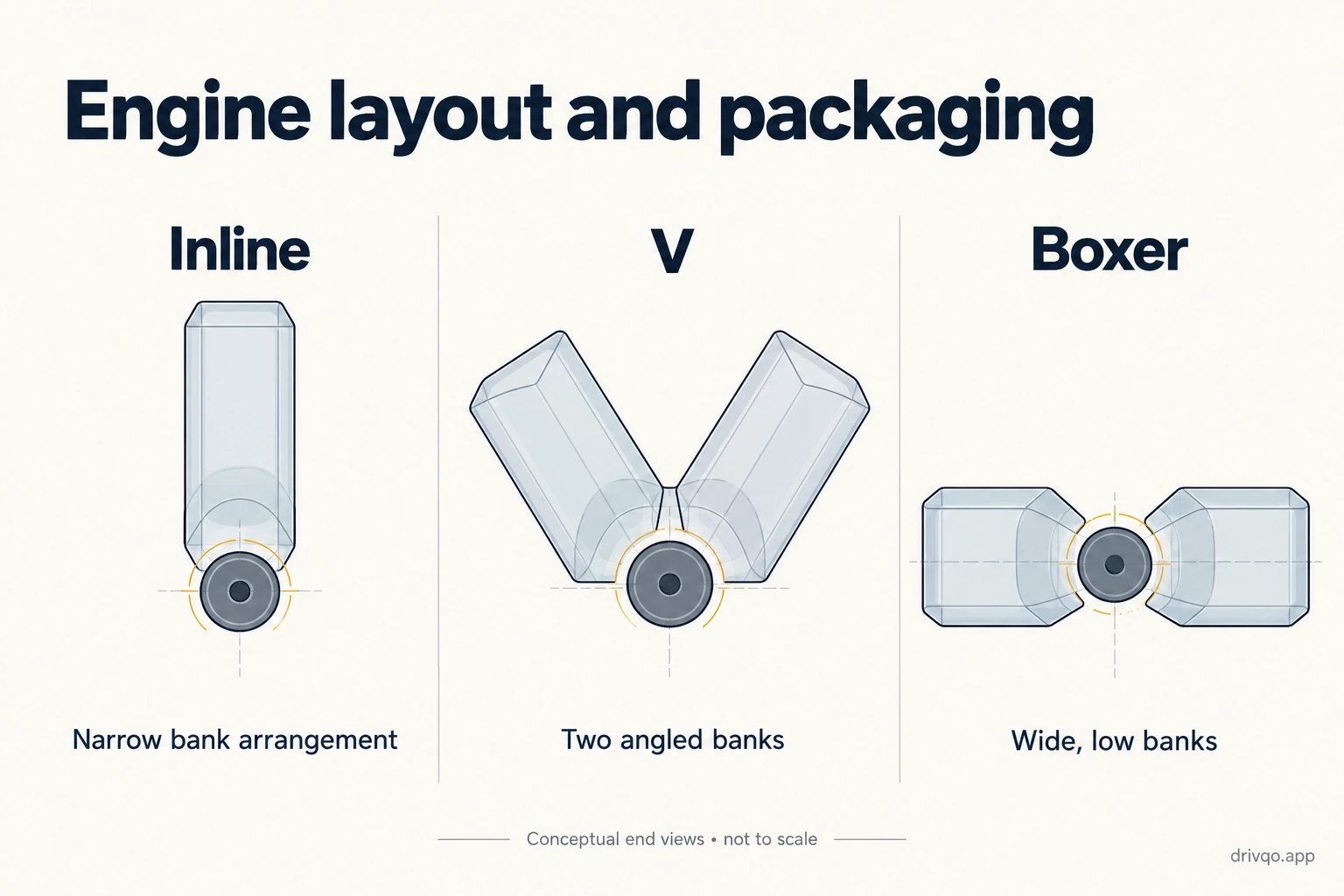
Layout envelopes only. These are not equally sized production engines or dimensional comparisons.
What the low shape actually buys
Cylinder orientation is a design opportunity, not a complete centre-of-gravity calculation. Subaru describes the horizontally opposed layout as supporting low engine placement. Its BRZ brochure makes the broader point especially clearly: the engine, seating position and roofline all contribute to the car's low overall layout. Subaru, What Is a Boxer Engine? Subaru, 2024 BRZ brochure, Light and Balanced
The distinction is practical. A low engine in a tall vehicle does not automatically produce a lower whole-vehicle centre of gravity than a different engine in a lower car. Nor does an engine's silhouette tell you where its crankshaft can sit once ground clearance, lubrication and crash structure are considered.
Width is a packaging requirement, not a universal measurement
With a cylinder bank extending to each side, the designer must find lateral room for both banks and their heads. This follows from the layout, but it is not evidence that every boxer is wider than every inline or V engine. Cylinder count, displacement, head design and accessories all affect the finished envelope.
The extra complication can also be a parts-count issue. Porsche notes that a flat engine requires two banks with associated valvetrain, cooling or injection equipment, and describes its manufacture as more involved than that of an inline engine. That supports a specific construction trade-off, rather than a claim that boxer cars are invariably expensive to own. Porsche, The flat engine tradition: manufacture and cooling
Engine shape and engine position are separate choices
A boxer can be used in different parts of a car. Subaru's BRZ is a front-engine, rear-wheel-drive example. Porsche describes the rear-mounted flat engine as central to the 911's design. A packaging advantage in one installation should not be assumed to work identically in the other. Subaru, 2024 BRZ brochure Porsche, Why is the Porsche 911 engine in the rear?
This matters when someone attributes a car's entire cornering behaviour to “the boxer.” Engine location changes mass distribution; tyres and suspension determine other parts of the response. Our rear-suspension guide separates another pair of often-confused choices: driven wheels and suspension layout.
What the layout cannot prove
Low height does not demonstrate lower fuel consumption, longer life or easier maintenance. Those require evidence about a particular engine and vehicle. The defensible conclusion is narrower and more useful: a boxer gives engineers a distinctive shape to package. Whether that shape is an advantage depends on the job the car is designed to do.
Illustration: AI-generated and checked against the explanation. Conceptual only; sources are linked beside the relevant claims.