The Citroën 2CV engine: why a small flat twin made sense
The production Citroën 2CV used an air-cooled flat-twin engine: two cylinders arranged horizontally on opposite sides of the crankcase. This is directly documented by Citroën, rather than something that has to be inferred from the shape of the bonnet. The company's 75th-anniversary history identifies the July 1949 production car with a 375 cc air-cooled flat twin. Citroën, Historic, Iconic, Legendary: 75 Years of the 2CV, 2023
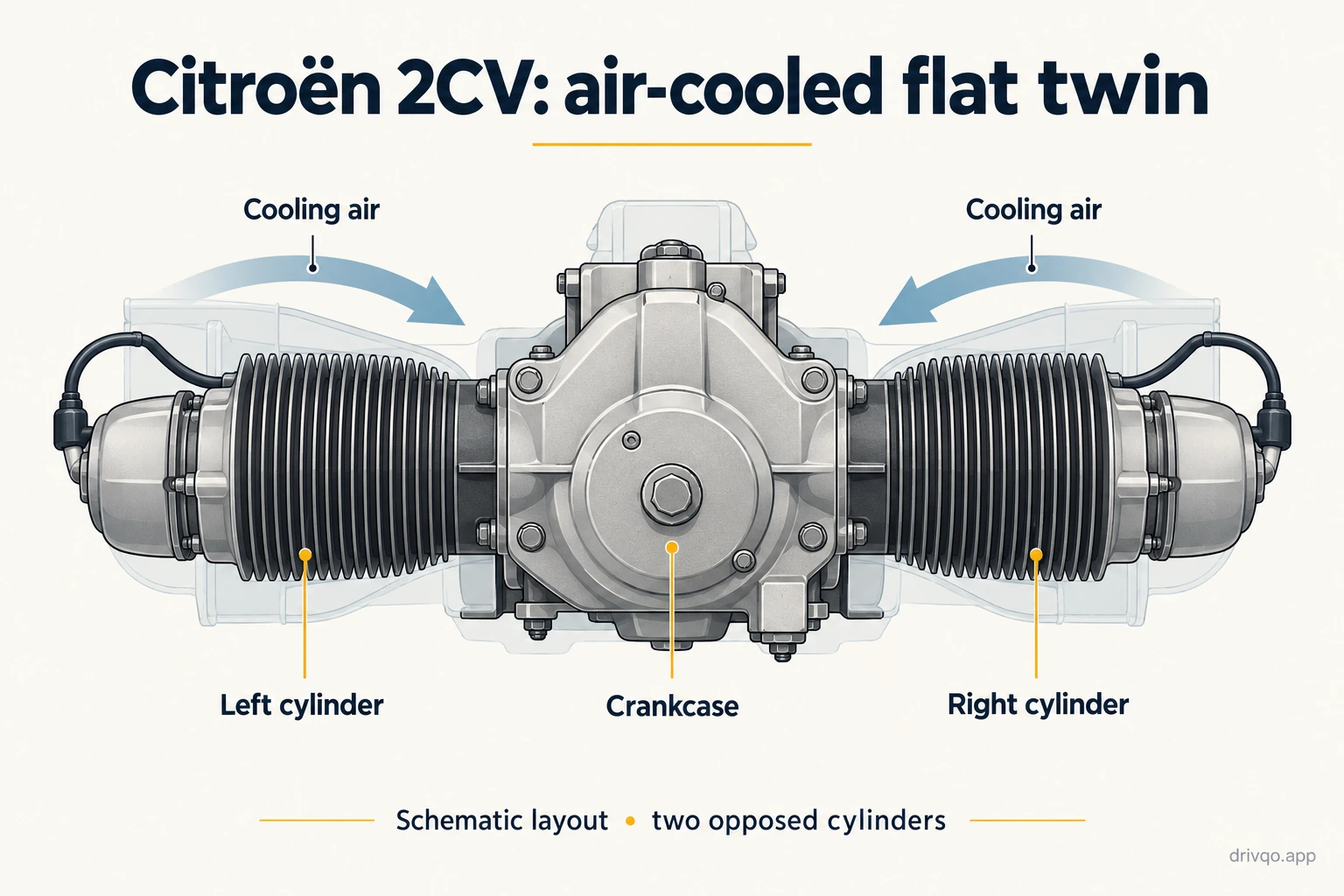
An orientation diagram, not a service drawing. It does not reproduce the exact internal geometry of a particular 2CV engine; cooling arrows are symbolic, not factory duct routing.
Decode the description one word at a time
“Twin” gives the cylinder count. “Flat” describes their arrangement. “Air-cooled” describes the principal route for rejecting engine heat. Those terms answer separate questions; a two-cylinder engine does not have to be flat, and a flat engine does not have to be air-cooled.
Citroën's centenary history explicitly calls the engine a two-cylinder boxer and identifies front-wheel drive and soft suspension as other parts of the 2CV's design. The engine was one element of a practical small car, not an isolated performance statement. Citroën, Der 2CV wurde zum Symbol der Freiheit, 2019, Motorisierung
The original engine is not every 2CV engine
The same history records 375 cc for the initial engine and 602 cc for the 2CV6 introduced in 1970. Those figures should stay attached to their versions. A statement about a late 2CV6 cannot automatically be used as the specification of the first production car. Citroën, 2019 centenary history, Motorisierung
The related van family also evolved. Citroën Origins records the 425 cc engine in the 2CV AZU in 1954. A shared family resemblance does not remove the need to identify the model and year before quoting displacement, output or equipment. Citroën Origins, Major changes: 2CV delivery van
Why the shape matters
Putting the cylinders to either side creates a different envelope from stacking an upright cylinder bank above the crankshaft. That gives designers a low basic layout to work with, while requiring lateral space. Our boxer-packaging guide explains that trade-off without assuming that every flat engine has the same dimensions.
The cooling description matters too. An air-cooled engine is still a heat-management system, not an engine that can ignore temperature. The label alone does not establish fan capacity, airflow distribution, lubrication requirements or service intervals. Those details belong to the correct technical documentation, not to a general historic overview.
Air cooling still needs controlled airflow
Citroën’s Charleston technical history specifies a nine-blade cooling fan for that version’s 602 cc engine. The fan makes the cooling description more concrete: airflow is supplied by hardware, rather than depending only on the car moving through the air. That same document identifies the A06/635 engine and its 74 mm bore and 70 mm stroke. These are Charleston specifications, not figures to attach to every 2CV built since 1949. Citroën, 40th anniversary of the 2CV Charleston, technical specifications
What the records establish
Citroën dates the public unveiling to 7 October 1948 and production to July 1949. Keeping those separate avoids making two different milestones appear contradictory. The historical material establishes the production flat-twin layout clearly; it does not justify treating every prototype or later derivative as mechanically identical. Citroën, 75 Years of the 2CV: origins and production
The 2CV is a useful example of how engine layout, cooling and vehicle purpose fit together. It is also a reminder that the most useful technical description is often a precise one: the right engine, in the right version, at the right date.
Illustration: AI-generated and checked against the explanation. Conceptual only; sources are linked beside the relevant claims.