CVT vs DCT vs AMT: what changes inside the gearbox?
A pulley CVT varies its drive ratio continuously. A DCT uses two clutch-controlled gear paths. A conventional single-clutch AMT automates the clutch and gear-changing operations of a manual-style transmission. All can remove the driver's need to operate a clutch pedal, but they do so with different hardware. Bosch, pushbelt CVT, Volkswagen, Polo DSG, Maruti Suzuki, AGS
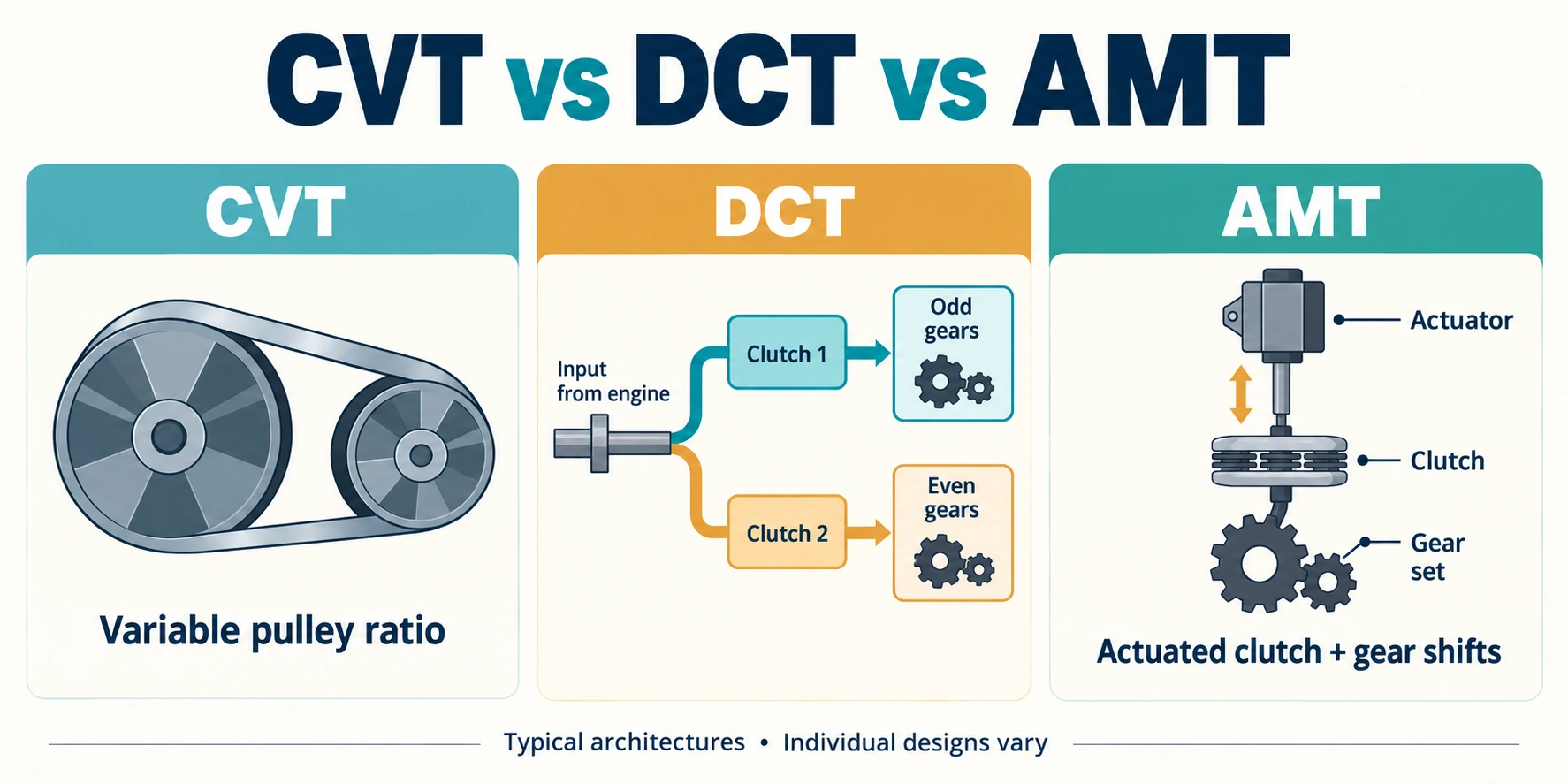
Architecture icons, not installation drawings. Launch devices and detailed layouts vary.
CVT: changing the effective pulley sizes
A common automotive CVT runs a belt between variable pulleys. Each pulley has conical faces. Changing their spacing changes the radius at which the belt runs. As one effective radius increases and the other decreases, the drive ratio changes without selecting another fixed gear pair.
The Bosch pushbelt is a steel assembly with elements supported by loop packs, not a rubber accessory belt. “Belt CVT” therefore describes a transmission principle, not the material used in a fan belt. Bosch, Pushbelt
The ratio can change without a conventional stepped shift, but the controller may still simulate steps. Toyota's Direct Shift-CVT also includes a separate launch gear to handle the initial low-speed region before using its belt drive. That is a specific implementation, so it should not be described as a feature of every CVT. Toyota, Direct Shift-CVT
DCT: two gear paths, one coordinated handover
In the Volkswagen DSG example, one clutch controls an odd-numbered gear path and the other an even-numbered path. The next gear can be selected in the inactive branch before the torque handover. The controller then coordinates clutch opening and closing.
This makes “two manual gearboxes working together” a useful starting analogy, although the actual packaging and controls are integrated. Preselection also explains why the expected next shift and a sudden request for another ratio are different control situations. Volkswagen, Polo engines and transmissions
DCT clutches can be wet or dry. Do not infer clutch type simply from the number of forward gears. Volkswagen describes both types within the DSG family. Volkswagen, DSG overview
AMT: automating the manual-style process
A conventional single-clutch AMT uses actuators to operate the clutch and select gears. Maruti Suzuki's Auto Gear Shift is a production example: electronic control takes over tasks that the driver would otherwise perform with a clutch pedal and gear lever. Maruti Suzuki, AGS
Because a single-clutch system has to manage the release and re-engagement of its drive connection during a shift, the coordination is important to how the change feels. The label alone does not establish how noticeable that transition will be in a particular car. Treat “AMT is always jerky” as an overgeneralisation, not an engineering specification.
| Architecture | How the ratio changes | Useful question when comparing cars |
|---|---|---|
| Pulley CVT | Effective pulley radii change | How does this version behave under sustained acceleration? |
| DCT | Torque transfers between clutch-controlled gear paths | Which clutch type and gearbox generation is fitted? |
| Single-clutch AMT | Actuators coordinate clutch release, selection and engagement | How well does its calibration suit the intended driving? |
A hybrid eCVT may use completely different hardware
The term CVT does not always mean pulleys and a belt. Toyota describes the 2016 Prius Hybrid Synergy Drive as combining an engine and two motor-generators through a planetary-type electronically controlled continuously variable transmission. Its variable relationship comes from an electromechanical power-split arrangement. The same three letters therefore do not imply the same internal parts. Toyota, 2016 Prius technical announcement
Which is best?
The architecture explains the mechanism; it cannot establish a universal fuel-economy or reliability ranking. A useful ownership comparison needs the exact model, gearbox generation, maintenance requirements and comparable evidence from the intended use.
Start with the hardware distinction, then ask for vehicle-specific evidence. For another common automatic layout, read how a torque converter works. For DCT cooling differences, see wet vs dry clutches.
Illustration: AI-generated and checked against the explanation. Conceptual only; sources are linked beside the relevant claims.