How synchromesh works: speed matching before gear engagement
A synchronizer uses friction to bring a selected gear and its connecting shaft to compatible speeds before their engagement teeth lock together. The blocker ring helps keep that sequence in order. It is a small mechanism with two distinct jobs: matching speed, then permitting a positive mechanical connection. Schaeffler, Intermediate Rings for Multi-Cone Synchronizer Systems, pp. 4–5
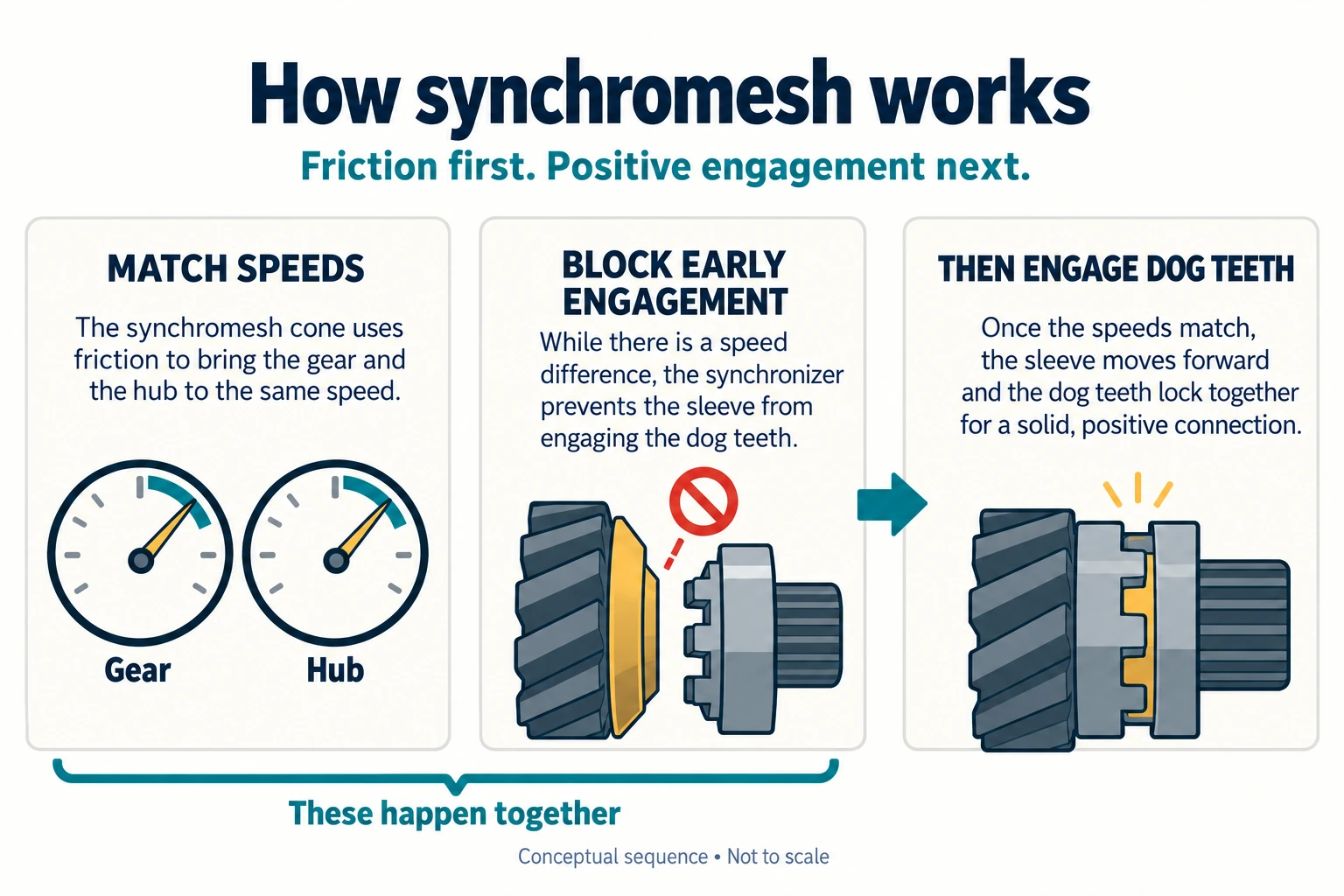
The blocking action occurs during speed matching; the cards separate the functions for clarity.
Which parts are being connected?
In the arrangement described here, the selected gear can rotate relative to the shaft until it is engaged. A hub is fixed to the shaft, and a sleeve slides along the hub. Moving that sleeve into the gear's clutching teeth connects the gear to the shaft.
The small engagement teeth are separate from the main gear teeth that transmit motion between meshing gears. This distinction matters: a normal synchronized change does not require pushing two large spinning gear wheels into mesh. The sleeve is completing a connection within an already meshing gear system. Schaeffler, component description, pp. 6–7
Follow one gear change
First, the sleeve moves toward the selected gear. The synchronizer's internal elements apply force to the baulk ring, bringing its friction cone into contact with the gear's matching cone.
Next, cone friction reduces the speed difference. The ring's limited angular displacement and the shape of the engagement surfaces prevent the sleeve from completing engagement too early.
Finally, the sleeve can engage the gear teeth. With the speed difference removed sufficiently, the blocking condition releases and the sleeve completes the positive connection.
A Nissan patent describes this sequence in a Warner-type synchronizer, including cone contact followed by engagement of the sleeve and gear teeth. Its particular invention concerns the spring arrangement, so it should not be read as a drawing of every manual gearbox. EP0090084B1, description, pp. 2–3
Why cone geometry matters
The driver's shift movement has to generate enough synchronizing torque within an acceptable effort and time. Cone angle, friction behaviour and the tooth geometry all influence that balance. An SAE gear-shift benchmarking paper identifies these among the variables used to evaluate shift quality. Krishnan, SAE 990041, public abstract
Multi-cone systems add friction interfaces. Their purpose is not to add another transmission ratio; they increase the synchronizing capability available within the mechanism. Schaeffler, multi-cone section, p. 11
Why oil is part of the mechanism
It sounds contradictory that a lubricated gearbox needs friction. The explanation is that different contacts perform different jobs. A synchronizer needs a controlled friction response at the cone to match speeds reliably.
The lubricant formulation therefore matters alongside the hardware. Bouffet's SAE paper examines synchronizer tribology and identifies design and lubricant properties, including base-oil viscosity, as relevant to performance. That is a reason to use the specified lubricant, not to assume a generic “slipperier” oil must improve shifting. The publicly available abstract does not provide a universal oil recommendation. Bouffet, SAE 2004-01-2022, abstract
What can we accurately say about wear?
Wear is more complicated than a count of gear changes. A 2020 SAE study considers unloaded synchronizer wear and discusses the influence of clearances, lubrication and torsional vibration. It shows why a broad claim that synchronizers wear only while the driver changes gear is incomplete. Only the public abstract was available for this article; no service-life figures are inferred from it. SAE 2020-28-0334, Unloaded Synchronizer Wear
A difficult shift is also not a complete diagnosis. The mechanism explains why friction and speed matching matter, but identifying a fault requires checks on the actual transmission and its clutch and linkage systems. An explainer cannot establish that a specific ring has failed.
Once the roles are separated, synchromesh is easier to understand: the cone handles the transition between speeds; the sleeve and engagement teeth establish the final drive connection.
Illustration: AI-generated and checked against the explanation. Conceptual only; sources are linked beside the relevant claims.