Intercooler vs radiator: two heat exchangers, different jobs
An intercooler removes heat from compressed intake air. An engine radiator removes heat from engine coolant. Both are heat exchangers, and both may sit near the front of a car, but they serve different circuits. Their similar appearance does not make them interchangeable. DENSO, Intercoolers, DENSO, Cooling Radiators
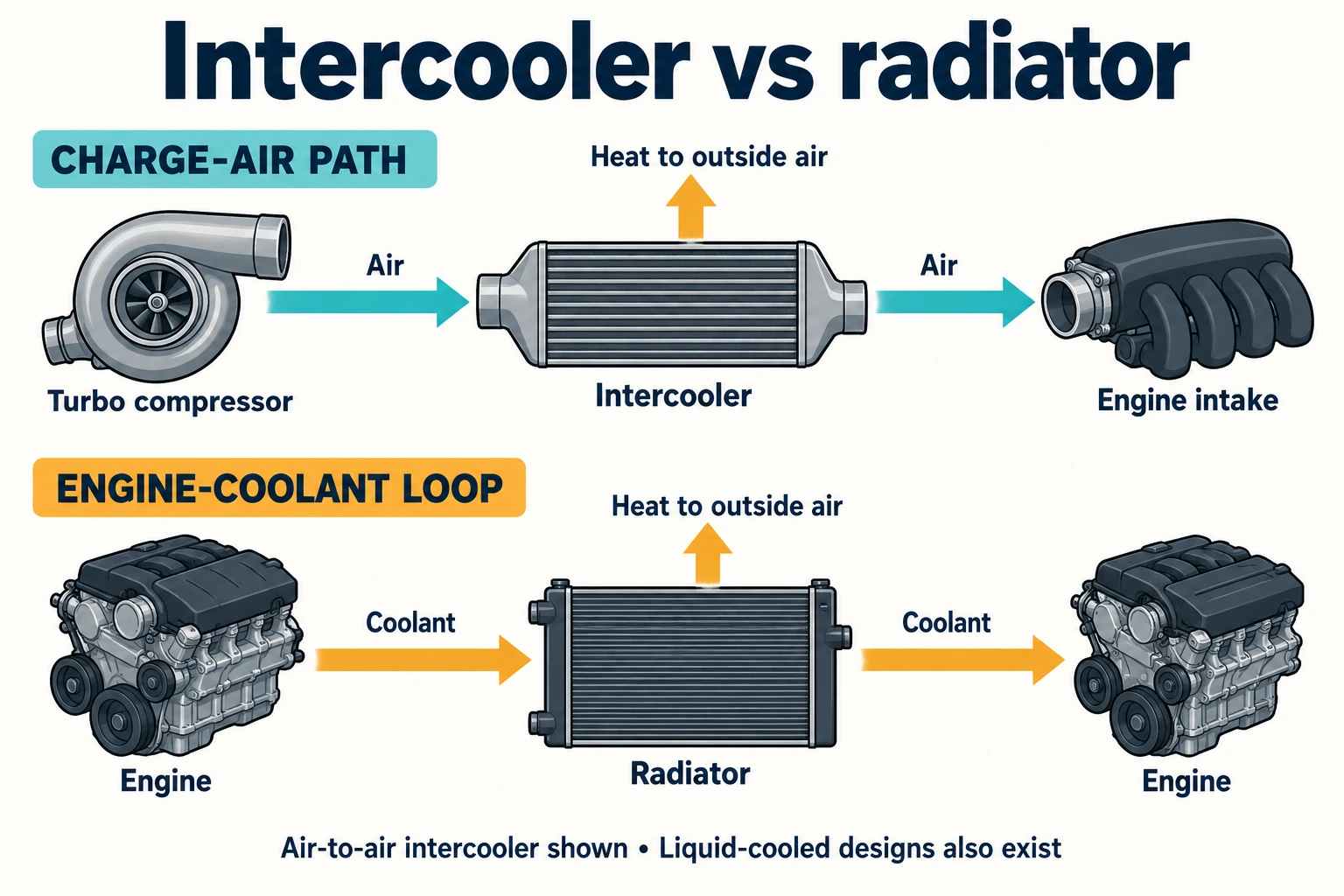
An air-to-air intercooler is shown. Liquid-cooled charge-air systems add another coolant circuit.
Why compressed intake air needs cooling
A turbocharger's compressor increases intake pressure, but compression also raises air temperature. Cooling that charge before it reaches the cylinders helps increase its density. DENSO describes the intercooler's job as removing this heat from the compressor outlet air. DENSO, Intercoolers
Garrett's turbo-system description also connects charge-air cooling with resistance to detonation. This does not mean an intercooler alone specifies the engine's power or safe boost pressure: it is one part of an induction and combustion system. Garrett, turbo-system technical catalogue
The important comparison is air condition before and after the cooler under stated conditions. A photograph of a large core cannot establish its performance during a sustained load.
What the engine radiator cools
Engine coolant absorbs heat while circulating through the engine. The radiator transfers that heat to outside air through its tubes and fins. Airflow can come from vehicle movement or a cooling fan when the available flow needs assistance.
DENSO notes that neighbouring heat exchangers can affect the airflow available to the radiator. The complete front-end cooling arrangement matters, not just the dimensions of one component. DENSO, Cooling Radiators
| Feature | Air-to-air intercooler | Engine radiator |
|---|---|---|
| Hot fluid being cooled | Compressed intake air | Engine coolant |
| Destination after cooling | Engine intake | Return through the engine's cooling circuit |
| Heat released to | Outside air | Outside air |
| Main role | Charge-air temperature management | Engine temperature management |
These are functional distinctions. Exact plumbing and component locations depend on the vehicle.
Why some intercoolers have coolant hoses
An air-to-liquid charge-air cooler transfers heat from the intake air into a liquid circuit. That circuit then needs a way to reject the heat. DENSO describes an arrangement integrated into the intake manifold and connected to a low-temperature cooling circuit.
The presence of coolant does not turn the charge-air cooler into the engine's main radiator. Trace which fluid is on each side of the heat exchanger and where it goes. That identifies the component more reliably than its shape. DENSO, liquid-cooled intercooler description
Cooling performance and pressure drop must be balanced
Air passing through an intercooler encounters resistance. The pressure at its outlet can therefore be lower than at its inlet. Garrett describes internal passage and fin design as a balance between heat transfer and pressure drop.
This matters because demanding a given pressure farther downstream may require more compressor work when the restriction is greater. A useful comparison should therefore consider temperature reduction and pressure loss together, at comparable airflow and operating conditions. A single temperature figure without those conditions leaves out much of the engineering. Garrett, Intercooler Core Engineering and Pressure Drop
Is a bigger heat exchanger always better?
External size alone is not enough to decide. DENSO documents a radiator development example in which a revised design achieved equivalent performance with a thinner core. The example illustrates how construction and heat-transfer design matter; it does not establish that thinner is always better either. DENSO, Engine Cooling System Advice—Radiators
For an intercooler comparison, ask for inlet and outlet temperatures, pressure drop, airflow and repeatable test conditions. For a radiator, ask whether it meets the cooling requirements of the complete vehicle. The right part is the one engineered for its circuit and duty, not simply the largest object that fits behind the grille.
To see where the intercooler sits in the wider induction system, read turbo lag vs boost threshold.
Illustration: AI-generated and checked against the explanation. Conceptual only; sources are linked beside the relevant claims.