How regenerative braking works—and why it sometimes feels weaker
Regenerative braking uses an electric machine as a generator to turn some of a moving vehicle's mechanical energy into electrical energy. That energy can be stored in the battery instead of all being dissipated through the friction brakes. The US Department of Energy describes this recovery process as a central feature of hybrid vehicles. DOE Alternative Fuels Data Center, hybrid basics
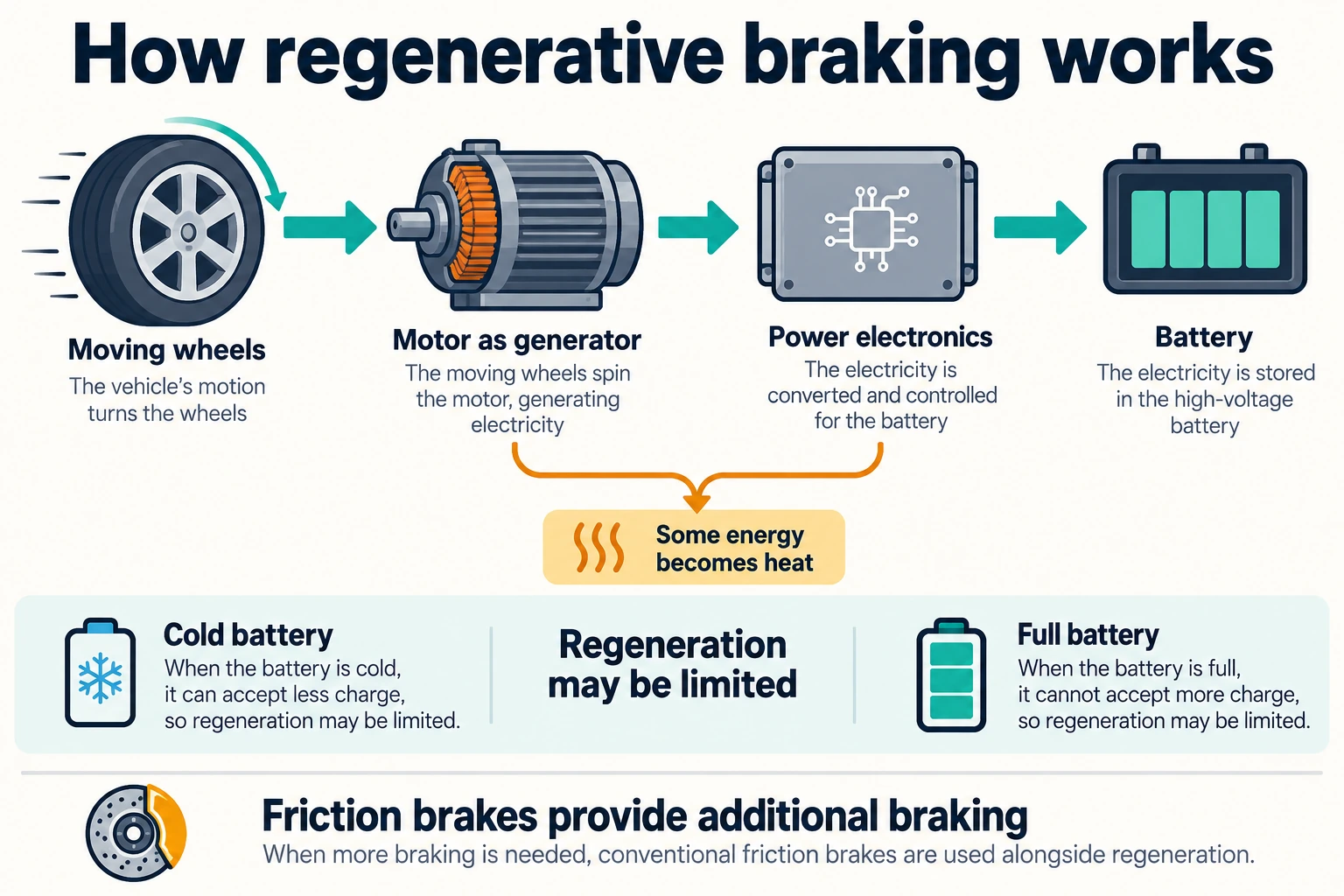
An energy-flow diagram, not a promise of a particular recovery efficiency.
The motor changes its role
During powered driving, the electrical system supplies energy and the motor produces driving torque. During regeneration, the moving vehicle drives the machine and energy flows toward the electrical system. The resulting electromagnetic torque opposes the motion, slowing the vehicle.
This does not require the car's wheels or motor shaft to start spinning backwards. It is the direction of energy transfer and the torque relative to rotation that changes. “The motor runs in reverse” is a misleading shortcut if it is interpreted as a physical reversal of the shaft. DOE, braking-energy explanation
Where does the recovered energy go?
The path is mechanical motion, electrical generation, power electronics and battery storage. Conversion is not loss-free. Some energy becomes heat along the way, and the amount stored depends on the system and operating conditions. Regeneration recovers part of the energy already in the moving vehicle; it does not create a new supply of energy. DOE, hybrid basics
It also does not recover every form of energy used during a journey. Tesla's range guidance describes partial recovery during deceleration and downhill travel, alongside other factors that consume energy. A descent is therefore not a guarantee that the energy spent climbing will all return to the battery. Tesla Model 3, Getting Maximum Range
Why a cold or full battery changes the braking feel
Generating electricity is only useful for recovery if the electrical system can accept it. Battery condition is one limit. Tesla's Model 3 manual explicitly notes that regeneration can be limited when the battery is cold or already fully charged.
The practical result can be a change in the deceleration obtained when the accelerator is released. The car's displays and any automatic use of friction braking depend on its version, software and settings. The Tesla example documents a real limitation; it is not a description of every EV's controls. Tesla Model 3, Braking and Stopping
How friction braking fits in
A vehicle still needs wheel brakes. In a blended system, the controller coordinates regenerative torque with friction-brake torque to meet the requested deceleration. Bosch describes brake-torque blending in its iBooster system and explains how friction braking supplements insufficient electrical braking torque. Bosch, iBooster, Bosch, E-Mobility from A to Z
The brake pedal does not have to communicate with the hydraulic circuit in the same way as a traditional system. Bosch's integrated power brake, for example, measures the driver's request, uses a pedal-feel simulator and generates hydraulic pressure with an electrically driven mechanism. This is one implementation of controlled braking, not a universal layout for all hybrids. Bosch, Integrated Power Brake
Does regeneration mean the brake pads never wear?
No. The DOE notes that regenerative braking can reduce brake wear, but this is not a fixed pad-life guarantee. Friction brakes remain part of the vehicle's braking system and maintenance requirements still apply. DOE, EV and hybrid maintenance
Likewise, a strong accelerator-lift response should not be treated as proof that the vehicle is recovering the maximum possible energy at every instant. Driver-interface behaviour, available electrical braking and total vehicle deceleration are related but distinct.
For the driver, the useful habit is to understand the car's own braking indications and follow its manual when regeneration is limited. For understanding the engineering, follow the energy: motion becomes electrical energy, subject to the machine, battery and control system's limits.
Illustration: AI-generated and checked against the explanation. Conceptual only; sources are linked beside the relevant claims.